


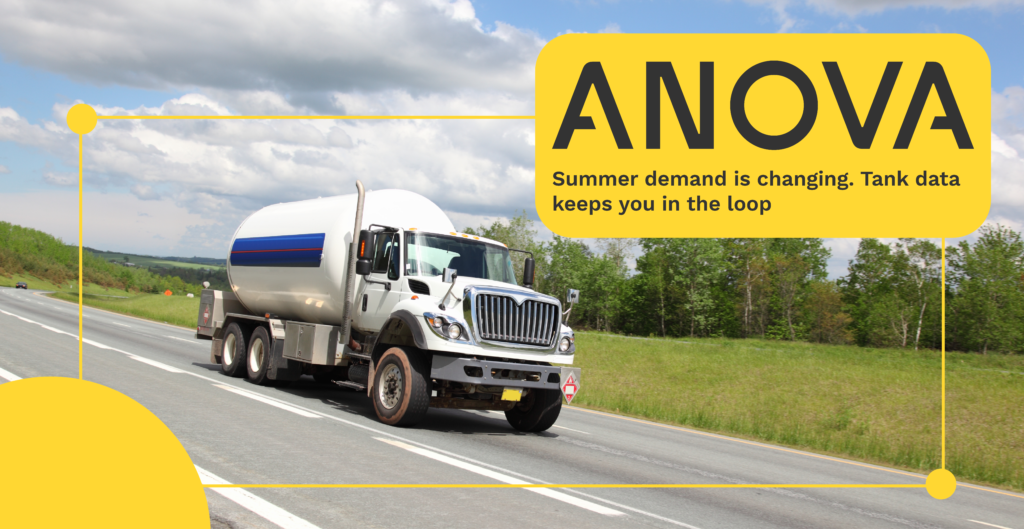
How leading LPG marketers are using tank telemetry to head off summer demand swings, tighten delivery routes and protect margin.

The shape of summer is changing
For LPG marketers, summer used to be the easy half of the calendar. Heating demand fell off, crews caught up on maintenance and dispatch ran on muscle memory. That picture has shifted. Crop drying, agricultural irrigation engines, commercial pool heaters, outdoor hospitality, standby generation for an increasingly stressed grid — the summer book of business now includes a wider mix of customers, each with its own consumption curve and its own tolerance for a missed delivery.
The marketers handling that shift well share one thing in common: they are no longer guessing at tank levels. They are reading them. Remote tank monitoring — the same technology many operators first adopted to protect winter heating customers — is becoming the operational backbone of summer route planning, customer retention and margin protection. The question is no longer whether telemetry pays back. It is how quickly an operation can put the data to work before the next demand spike.
From reactive to predictive
A traditional summer route is built on a schedule — every 30 days, every 45, every will-call. The trouble with a schedule is that it does not know what the tank knows. A 1,000-gallon tank serving a crop dryer in late August does not consume the way it did in late June. A resort with an unusually cold shoulder season burns through pool heat ahead of plan. A standby generator that never ran last summer ran 12 times this one. None of that shows up on a calendar. All of it shows up on a monitor.
Anova customers who shift from scheduled to telemetry-driven delivery routinely see meaningful changes in three places. Delivery intervals extend because trucks stop rolling on tanks that do not need fuel. Run-outs decline sharply because the tanks that do need fuel surface in the queue early. And dispatchers spend less time on the phone reconciling customer reports of “low” or “empty” with what the tank actually holds. The cumulative effect is a leaner, calmer summer operation — fewer emergency runs, fuller trucks per route, and a clearer view of where the next gallon should go.
What summer readiness actually looks like
Operational readiness for summer demand is less about adding capacity than about removing blind spots. Three practices separate the marketers who treat telemetry as a tool from the ones who treat it as infrastructure.
First, they instrument the right tanks. Not every account needs a monitor, but the accounts that drive summer revenue almost always do — ag, commercial, multisite tanks, anything with consumption that swings on weather or production. Coverage is targeted, not universal, and it pays back fastest where consumption is least predictable.
Second, they pair monitors with alerts that mean something. A flood of low-level notifications is noise. A short list of well-tuned alerts — anomalous draw, projected run-out inside a defined window, pressure or temperature thresholds on critical assets — is signal.
Operations teams using Anova’s analytics typically narrow their alert universe in the first 60 days and report fewer false alarms and faster responses on the ones that matter.
Third, they put the data in front of the people who route trucks. Dashboards that live on a manager’s laptop are interesting; dashboards that drive the morning dispatch meeting are operational. The marketers getting the most out of monitoring have closed that loop — telemetry feeds the route, the route feeds the truck, and the truck rolls with a full understanding of what each stop actually needs.
The numbers worth tracking
LP Gas readers do not need another vendor pitch. They need a short list of metrics to watch. Four are worth putting on the wall this summer:
- Average delivery interval, by route. Telemetry should be lengthening it.
- Run-out incidents per 1,000 deliveries. Telemetry should be lowering it.
- Gallons delivered per stop. Trucks should be working harder per visit, not running more often.
- Customer churn on monitored accounts versus unmonitored ones. The gap is usually larger than expected.
A smarter summer, and a more profitable winter
The marketers who will look back on this summer as a good one will not be the ones who ran the most trucks. They will be the ones who ran the right trucks to the right tanks at the right time — and have the data to prove it. Telemetry is what makes that possible. The data, the routines and the dispatcher trust built over a summer of telemetry-driven delivery do not reset in November — they carry into peak heating season, where every avoided run-out and every well-timed delivery shows up directly in margin. Anova works with LPG operations of every size to put that capability in place, on the tanks where it matters most, ahead of the season where it counts.
This page was produced by North Coast Media’s content marketing staff in collaboration with Anova. NCM Content Marketing connects marketers to audiences and delivers industry trends, business tips and product information. The LP Gas editorial staff did not create this content.