


Protecting underground tanks with impressed current cathodic protection
I wrote about underground propane tanks and their protection from corrosion in an article in the September 2025 issue. There has been some activity on this topic, so I plan to share some information on that.
First, I want to briefly describe another type of cathodic protection (CP) that is covered in the LP Gas Code: impressed current. This system uses power from the grid or, possibly, a local source, rectifies it or conditions it as required, and applies it to containers or, more usually, pipelines. The impressed current replaces current from the sacrificial anode, most often used on UG propane tanks.

A big advantage of impressed current is that it is usually a reliable source of electricity that should stay constant for the life of the installation. Yes, there may be occasional power outage interruptions, but the protection should return as soon as power is restored. That’s a big if, so the LP Gas Code requires inspection and testing of all sources of impressed current at intervals not exceeding two months. There’s also a requirement for inspection and testing of installations annually. Short power outages should not present a significant corrosion opportunity, but testing will ensure that. Sacrificial anodes are not subject to power outages, as they are part of a complete, individual system.
You need to keep the anode system individual. There are instances where the anode system was not isolated from the power grid or from the attached piping system, which may travel underground to a distant building. The anode can be consumed, protecting far more than was intended. Be sure a dielectric union is supplied for isolating the protection to only what is intended.
The LP Gas Code also specifies a testing schedule for anode systems. See section 6.20.3.2. The code does not specify a testing method. That topic is up for debate. The training our inspectors received several years ago from recognized industry experts specified at least four test locations around or along the tank, with all readings more negative than -0.85 V for the system to pass. This is also specified in the Propane Education & Research Council (PERC) education program currently in use for corrosion prevention in the Learning Center. Some vendors are saying you may be able to pass the test with only one test location meeting the voltage requirement. Logic tells me that a quadrant that doesn’t meet the voltage requirement is an unprotected quadrant. I’ll admit that my logic on electrical systems is sometimes errant. Show me!
Further, there is a company marketing a system that continuously monitors and reports on the cathodic protection for the tank where it is installed. I’m not saying that it doesn’t do what it claims, but I don’t understand how it can when its testing does not comply with the various testing programs specified in the industry. It uses one test cell buried with the tank to monitor the voltage from the anode bag. In truth, it has the capability to be connected to four test cells, but it is intended to be used with one. All test methods I know of say to test at the ground surface. I don’t know the effect of burying the test cell. I’m not one to stifle innovation, but it seems to me that a new and different method needs accreditation, especially when what it’s testing is out of sight.
There is some 58-committee activity that may result in testing methods being specified in the LP Gas Code. If implemented, that will not appear until late 2027. Our policy in North Carolina will be to follow our training until the code changes and specifies something different, or we accept a different training regimen.
Also, follow the tank installation instructions, especially examining the coating for damaged areas and keeping the backfill free of rocks and abrasives. Too many tanks’ lives are cut short, some with harmful incidents, by corrosion that concentrates on a few small holidays (imperfections) in the tank coating. A pinpoint holiday can result in what looks like a bullet hole in a tank after as little as several months of its life underground.
Richard Fredenburg is an LP gas engineer at the North Carolina Department of Agriculture and Consumer Services, Standards Division. He is also a member of NFPA’s Technical Committee on LP Gases. Contact him at richard.fredenburg@ncagr.gov or 984-236-4752.
NOTE: The opinions and viewpoints expressed herein are solely the author’s and should in no way be interpreted as those of LP Gas magazine or any of its staff members.
Featured homepage image: DarcyMaulsby/iStock/Getty Images Plus
Related Articles
Avoid issues with wheel stops and temperature correction
What the LP Gas Code says about installing, testing cathodic protection systems
You May Also Like
-
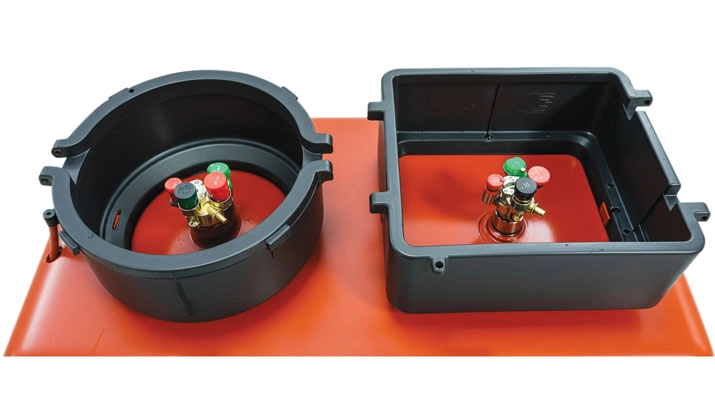
TRIARC Tank introduces square shroud
Sep 19, 2026 -

Basin Coop acquires Inter-Mountain Propane
Sep 17, 2026




Subscribe to LP Gas
If you enjoyed this article, subscribe to LP Gas to receive more articles just like it.