


Impacts of Winter Storm Fern on propane market fading
Trader’s Corner, a weekly partnership with Cost Management Solutions, analyzes propane supply and pricing trends. This week, Mark Rachal, director of research and publications, shares how propane supply and demand are normalizing after the effects of Winter Storm Fern.
Catch up on last week’s Trader’s Corner here: Steady propane prices for 2025-26 winter
Winter Storm Fern had a significant impact on the U.S. energy scene, both from the supply and demand sides. In recent Trader’s Corners, we have looked at some of those impacts.
Officially, Fern occurred from Jan. 23-27. It brought deadly ice and snowstorms across much of the nation. Twenty-four governors issued emergency declarations in its wake. It is estimated that it directly affected the lives of 230 million people.
Sadly, at least 171 deaths have been attributed to the storm. A million people, mostly in the South, lost power.
Its impact on the U.S. energy industry has largely faded into the past, but even now, supply is still ramping back up. Prices of heat sources like propane, natural gas and heating oil are in various stages of normalizing.
Natural gas was the most volatile.
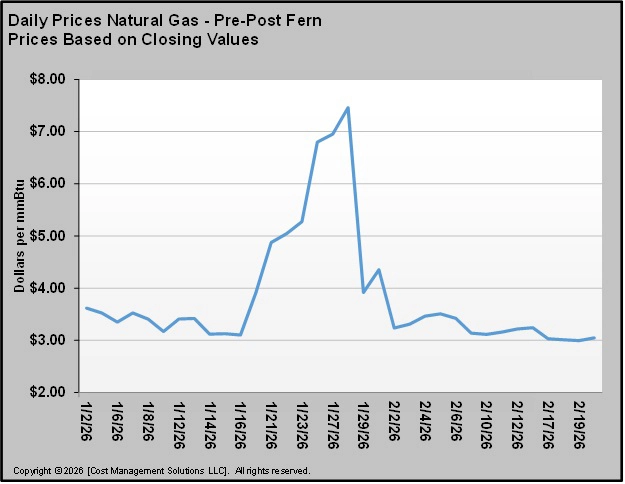
Yet it has normalized quickly. In fact, it is currently lower than it was before the storm.
Propane prices remained relatively well-behaved during Fern, at least at the trading hubs.
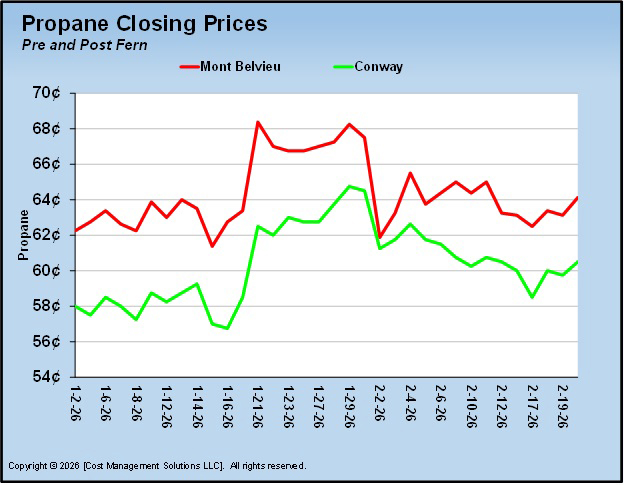
Propane prices only increased about 6 cents during the storm. Mont Belvieu is about where it was before the storm, and Conway is still slightly higher and is taking longer to give up the storm effect on its pricing.
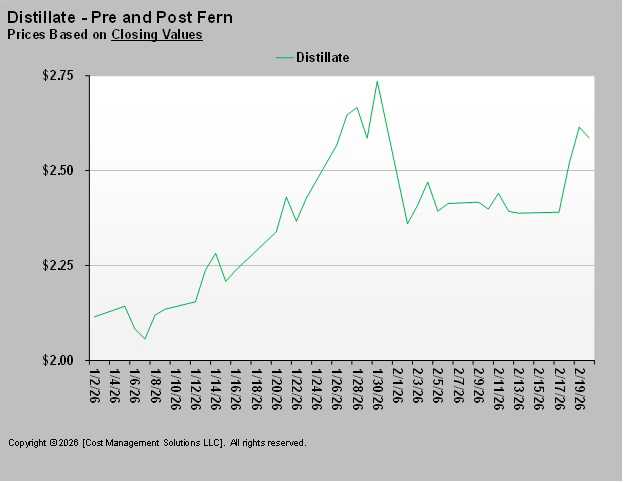
Heating oil has not returned to pre-storm pricing. However, a geopolitically fed rally in crude’s price may be largely to blame.
One fundamental of propane was perhaps the most impacted by Fern of any energy fundamental, propane or otherwise. That was propane production. We believed the oversized impact on propane production relative to the production of crude and natural gas was likely due to propane rejection at natural gas processing plants.
We took the subject of propane rejection up in our Jan. 30 Trader’s Corner and further looked at the drop in propane production the following week. We are not going to revisit those topics here, but if you missed them, they are probably worth a look. Those articles will get into the causes of the sharp drop in propane production.
Our focus here is not on the cause so much as the recovery.
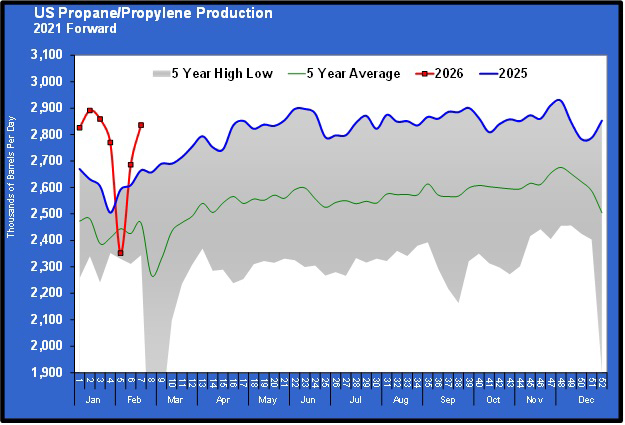
Just before Fern hit, propane production was at 2.891 million barrels per day (bpd), not far off the 2.928-million-barrel record high. Under the influence of the storm, it fell all the way to 2.352 million bpd. That was well below the five-year average, which says something given the steady growth in production.
The good news is that production has largely recovered. It is not quite back to pre-storm levels but is rapidly getting there.
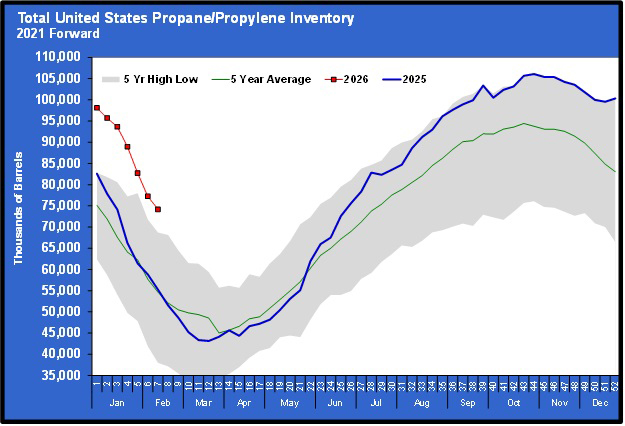
Propane inventories took a hit during the storm but had the cushion to easily absorb the blow. In fact, through the entire event, they remained at record highs for this time of year.
They continued lower this past week, of course, but the draw was less than the five-year draw for week 7 of the year. Its level increased in percentage over last year and the five-year average.
Propane traders are feeling no pressure relative to propane supply. Consequently, propane prices were up 1.58 percent at Mont Belvieu ETR last week against a 5.57 percent increase in crude. Conway was up only 0.83 percent.
Charts and tables courtesy of Cost Management Solutions.
To subscribe to LP Gas’ weekly Trader’s Corner e-newsletter, click here.
You May Also Like
-
Propane price spreads encourage exports
Oct 19, 2026 -

Faces & Places: October 2026
Oct 19, 2026




Subscribe to LP Gas
If you enjoyed this article, subscribe to LP Gas to receive more articles just like it.