


Buyers see increase in propane inventories
Trader’s Corner, a weekly partnership with Cost Management Solutions, analyzes propane supply and pricing trends. This week, Mark Rachal, director of research and publications, examines the remarkable build in propane inventories after an earlier draw.
Catch up on last week’s Trader’s Corner here: Retailers share about the state of propane supply in 2026
The draw on propane inventories started early this year, driven by high export demand. The inventory-build period ended in August with inventories flat overall. Then they started trending down in September. By the end of October, inventory was essentially even with last year. With export demand high, it took a relatively small increase in seasonal U.S. domestic demand to result in a call on inventories to make up the shortfall between supply and demand.
The result was that a significant surplus of propane inventory over last year’s levels was quickly eliminated. Remarkably, propane inventories have built over the last two weeks.
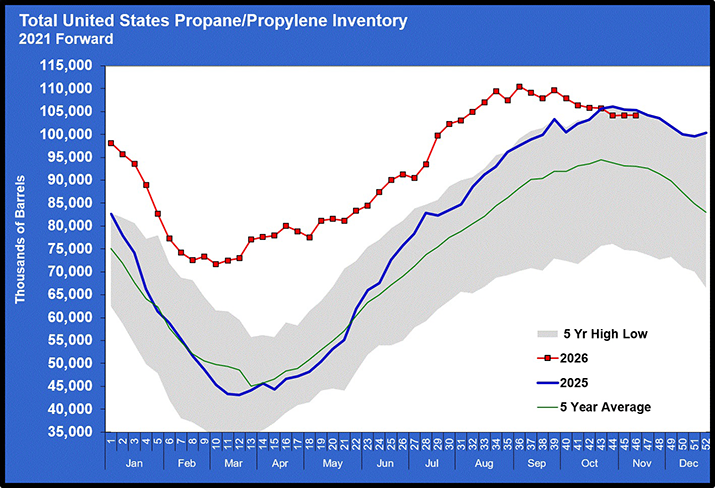
The builds have been very small, but they have come in weeks that would normally see draws on inventory, so they were not insignificant in that respect.
As of the week ending Nov. 13, U.S. propane inventories had climbed to 104.211 million barrels on the back of two weeks of builds that totaled about 100,000 barrels. That put total U.S. inventories at just 1.150 million barrels, or 1.1 percent, below last year. They were 11.163 million barrels, or 12.12 percent, above the five-year average.
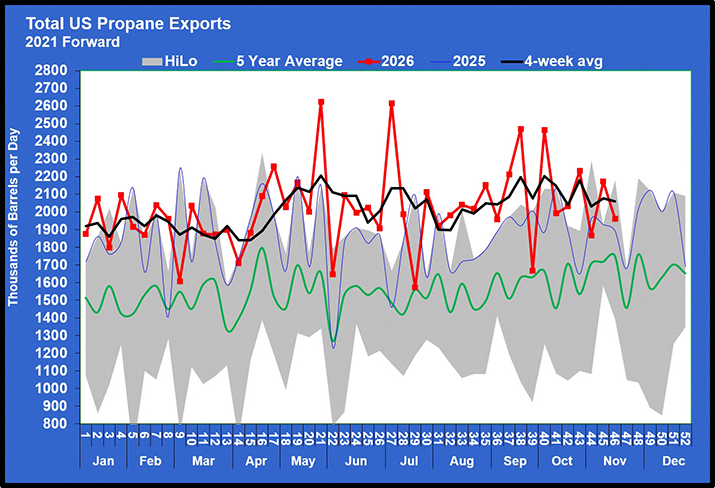
Propane exports have remained high, averaging 165,000 barrels per day (bpd) more this year than last. However, since early October, the export volume trend has been slightly down. There was some movement of liquefied petroleum gas (LPG) out of the Middle East, which may have resulted in this trend change. However, there were reports of LPG tankers being hit around the Strait of Hormuz recently. That has resulted in propane prices resisting following crude prices lower.
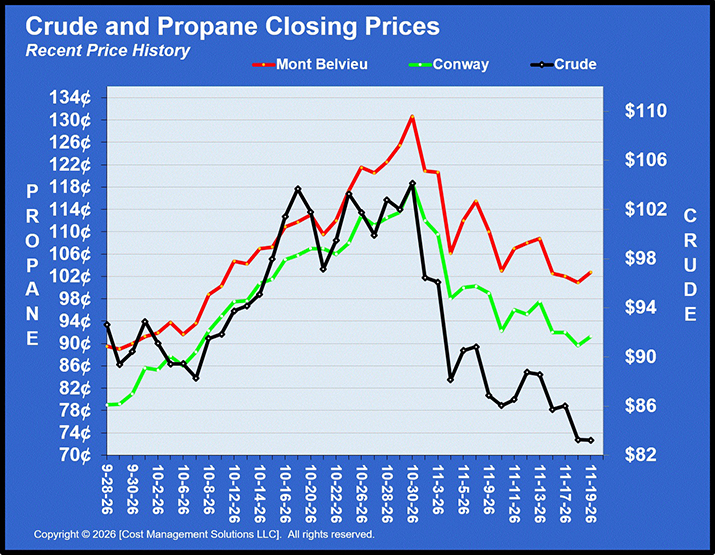
Crude prices dropped sharply following the midterm elections in the United States, pulling propane prices down with them. But the fall in propane has been less pronounced than the fall in crude. And, as Chart 3 shows, propane prices went against crude last Thursday, moving higher even as crude continued in its downtrend.
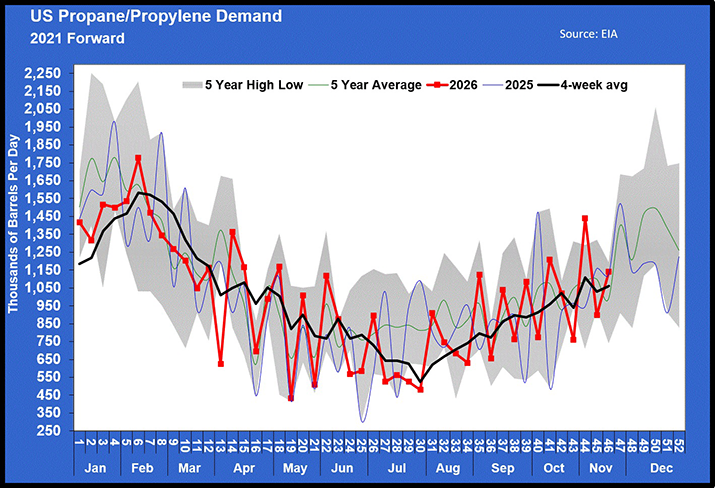
U.S. demand is following its seasonal pattern, rising since August. So far, U.S. domestic demand has averaged 2,000 bpd more this year than last. That makes it remarkable that U.S. propane production and imports have been enough to match demand these past couple of weeks, resulting in no call on inventories.
Imports are playing a minor role. They have averaged 3,326 bpd more this year than last. And on that front, it was very positive to see Canadian propane inventories rise in October after falling in September. The 931,000-barrel October build was unusual and put Canadian inventories above last year and just under the five-year average. Hopefully that means exports to the United States will remain at least equal to last year.
The primary reason that supply and demand have been roughly equal the last two weeks has been a bounce in U.S. propane production.
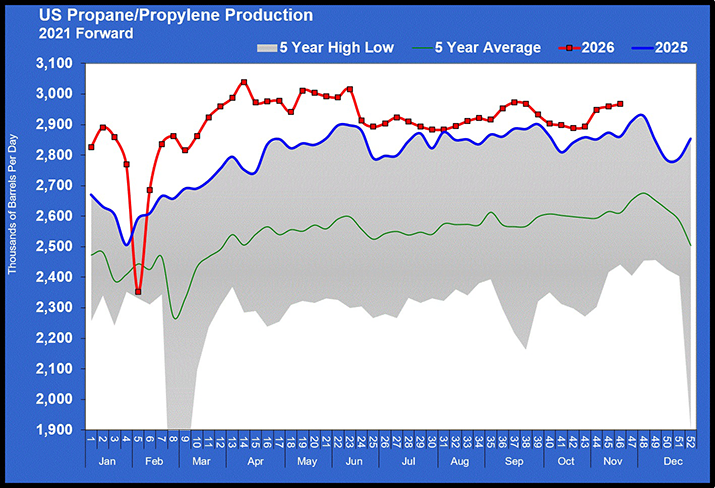
U.S. propane production has set a new five-year high in all but one week this year, when a winter storm in February caused production problems. The recent bounce in propane production has not matched the 3.038-million-bpd record rate set in April. Production last week was 2.967 million bpd, but it has been enough to match demand and end the calls on inventory to augment supply. And with the production rates that were consistently reached in April, May and June, even more production is possible.
Calls on inventories will resume, but the respite in the inventory drawdown was exactly what propane buyers needed to take some of the starch out of propane pricing. It also gives hope that if exports from the Middle East are restored soon, buyers might avoid a much firmer pricing environment for the end of this winter. Buyers are not out of the woods yet in that regard, but the last two weeks have certainly helped future pricing prospects.
Charts courtesy of Cost Management Solutions.
To subscribe to LP Gas’ weekly Trader’s Corner e-newsletter, click here.
You May Also Like
-
Record-high crude production
Nov 9, 2026





Subscribe to LP Gas
If you enjoyed this article, subscribe to LP Gas to receive more articles just like it.