


Closing of Strait of Hormuz impacts energy exports
Trader’s Corner, a weekly partnership with Cost Management Solutions, analyzes propane supply and pricing trends. This week, Mark Rachal, director of research and publications, explains the threat Iran poses to energy shipping through the Strait of Hormuz.
Catch up on last week’s Trader’s Corner here: Impacts of US-Iran conflict on propane market
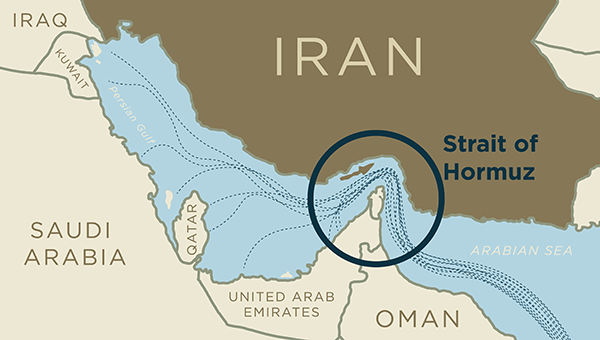
A small sliver of water off the southern coast of Iran has become the center of the energy universe.
Before Feb. 28, when the United States began Operation Epic Fury and Israel began Operation Roaring Lion against Iran, around 20 percent of the world’s crude supply traversed the narrow Strait of Hormuz connecting the Persian Gulf and the Gulf of Oman. The Gulf of Oman is connected to the Arabian Sea, and from there, ships can reach the rest of the world.
Since the war began, the strait has been de facto closed. Shipping companies have been unwilling to risk going through the strait due to the threat of being attacked by missiles, drones and possibly mines by Iran.
In addition to crude, liquefied natural gas (LNG) exports have been impacted. Qatar is the world’s third-largest LNG exporter behind the United States and Australia. It accounts for about 18 percent of global LNG exports. It is shutting in production as it is unable to export its natural gas. Countries like Iraq and Kuwait are almost totally dependent on moving crude exports through the Strait of Hormuz.
From a U.S. propane retailer’s perspective, the war is only having a moderate direct impact. Due to high inventories and good production, propane prices have lagged the sharp run-up in the price of other energy sources.
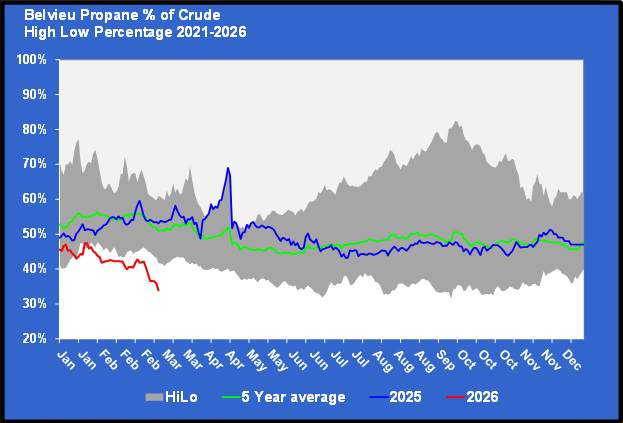
Mont Belvieu (MB) ETR propane was valued at an already-low 42 percent of West Texas Intermediate (WTI) crude’s value the day before the war began. Since then, MB ETR has dropped to just 34 percent of the value of WTI crude. At this time last year, MB ETR propane was valued at 53 percent of the value of crude.
Despite all the upward pressure on energy prices caused by the war, MB ETR propane is trading below where it was this time last year. It is currently at 77.25 cents per gallon, whereas on March 13, 2025, it was trading at 85.25 cents per gallon.
Thanks to prices being low when the war started and the lag in price gains experienced by other energy products since, propane remains a relatively cheap source of energy. Distillates, including heating oil and diesel, are currently trading at New York Harbor at $3.81 per gallon. Propane would need to be valued at $2.52 per gallon to be at an equivalent Btu value. Instead, propane is a third of that price.
Though things have gone well for propane retailers and their customers so far, there are both direct and indirect effects caused by the war that could negatively impact both.
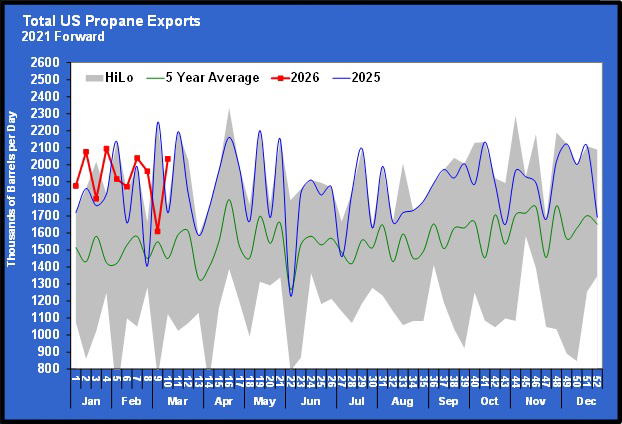
The war has caused a loss of propane supply from sources in the Middle East. This supply change is increasing the demand for U.S. propane. Propane exports jumped by 426,000 barrels per day (bpd) last week, and we expect them to be near capacity (somewhere around last week’s 2.035 million bpd) as long as the Strait of Hormuz remains closed. This jump in exports alone is likely to tighten U.S. supplies and put upward pressure on prices. We are not concerned about a huge surge in prices, but a Btu of propane, just like other Btus, is going to go up if the fighting continues disrupting supplies.
Propane retailers and their consumers can be impacted negatively in indirect ways due to the conflict as well. The higher price of energy could cause another round of inflation. If the war goes on for too long, it could cause a global economic recession that could hurt us all in a myriad of ways.
These circumstances mean the war between the United States and Iran is really a war for the Strait of Hormuz. The way the regime in Iran can stay in power despite all the military success by the United States and Israel against it is to remain capable of threatening shipping on that vital waterway.
Iran has attacked over a dozen of its neighbors since the war began. Iran likely hoped that the attacks would cause them to turn against the United States, resulting in them demanding the United States close military bases in their country, end the war or both. It has not had the desired impact and, if anything, it has caused a deterioration in those countries’ relationships with Iran.
Where Iran has been successful is in putting economic pressure on the United States to end the war and perhaps save the regime. This pressure has been exerted by essentially halting all ship traffic through the Strait of Hormuz. We suspect that the regime is going to keep enough of its ballistic missile and drone arsenal available to threaten the strait indefinitely. It has already attacked over a dozen ships. Three successful attacks were made on March 12. Two of the attacks used naval drones on ships anchored in Iraq’s territorial waters. The message was clear: If the United States continues to attack Iran, no ship in the region will be safe.
Though the United States says regime change in Iran is not a goal, it has not hidden the fact that it hopes that it is an outcome of the war. The new supreme leader of Iran is the son of the former supreme leader. His father, mother, wife and son were killed in the first attack of the war. There are reports that he was severely injured during the attack. If he remains in power in Iran, there is no doubt that he will use his position and the resources of his country to seek revenge.
If the United States is to have time to achieve regime change, which Iran has made clear is going to take more than an air and naval campaign, the Strait of Hormuz must be opened.
The world is adjusting in ways that provide more time for that to occur. For example, Saudi Arabia is exporting more of its crude through the port of Yanbu on the Red Sea than before the war. It has increased exports from there from 2.8 million bpd to 7 million bpd by utilizing an east-to-west pipeline.
The 32 industrial nations that are members of the International Energy Agency have agreed to an unprecedented release of 400 million barrels of crude from strategic reserves. For its part, the United States has committed to releasing 172 million barrels over 120 days.
Additionally, the United States has lifted sanctions on Russian crude through early April. Russia has many tankers full of crude that have been unable to find homes due to sanctions, but now they are moving to buyers.
Buyers of Middle Eastern crude are turning to alternative energy sources such as coal to lessen the impact of lost supplies.
All these adaptations, as well as others that will no doubt develop out of desperation, will give the United States a little more time to figure out how it can win the battle for the Strait of Hormuz. But for this war against Iran to truly be successful from a U.S. perspective, the battle for the strait will have to be won and shipping will have to resume.
It appears the administration is feeling the pressure from higher energy costs. One senses messaging from the administration that is providing an off-ramp – one in which the United States will declare victory and end hostilities, but with the current Iranian regime remaining in place. If that occurs, it will be framed that the Iranian people were given the opportunity to take back their country but failed to do so.
Iran’s citizens are unarmed. To rise and overthrow the regime, armed elements that currently support the regime would have to turn against it. There is no indication that is happening. Or the United States and Israel will have to figure out how to arm Iranian citizens who oppose the regime. That is a long game that, unless the situation with the strait changes, will not have time to come to fruition.
Otherwise, the United States is left to do something that has never been done, which is to cause a regime change with just an air war. Or it must completely degrade Iran’s capability to threaten the Strait of Hormuz. Iran has released pictures of massive underground bunkers full of land and sea drones, missiles and mines. If those are indeed current and not pre-war photos, it appears Iran has the capability to extend the threat to the Strait of Hormuz indefinitely.
With the recent attacks on shipping, Iran’s regime sent a clear message: If you want us out of power, you will have to match our resolve to stay in power.
If the Strait of Hormuz remains closed, they know that time is on their side. If ships start moving again, then perhaps there will be time for armed elements inside Iran to turn against the regime. If they do, it will likely be a long and bloody civil war with an uncertain outcome. Russia and China will support the current regime, while the United States and Israel, and possibly some of their allies, will support the opposition. And we shouldn’t be surprised if the neighbors that the Iranian regime is bombing don’t end up supporting the current regime. Otherwise, if the Iranian regime survives, they will be fighting them in perpetuity.
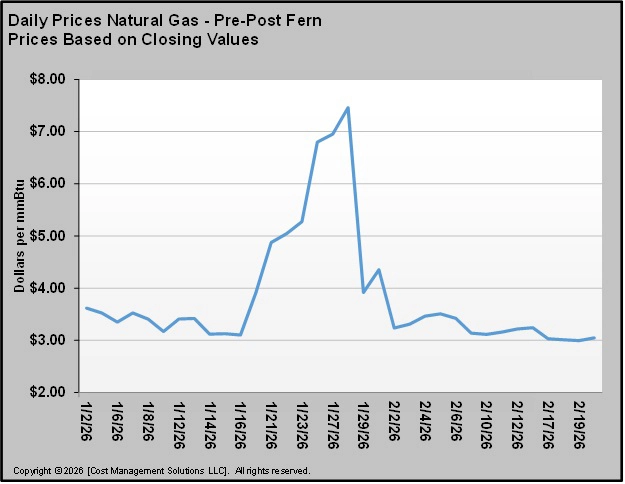
Charts courtesy of Cost Management Solutions.
To subscribe to LP Gas’ weekly Trader’s Corner e-newsletter, click here.
You May Also Like
-
Impacts of US-Iran conflict on propane market
Mar 9, 2026 -
Making sense of volatile crude inventories
Mar 2, 2026




Subscribe to LP Gas
If you enjoyed this article, subscribe to LP Gas to receive more articles just like it.