


The ‘end of the beginning’ of the US-Iran war
Trader’s Corner, a weekly partnership with Cost Management Solutions, analyzes propane supply and pricing trends. This week, Mark Rachal, director of research and publications, theorizes about the next stage in the U.S.-Iran war.
Catch up on last week’s Trader’s Corner here: Propane market outlook
At the outset of World War II, Great Britain had many setbacks, with Dunkirk being one notable example. In that battle, Great Britain lost nearly its entire expeditionary force of around 400,000 soldiers, who had gone to the European continent to aid France. French soldiers and some British soldiers sacrificed themselves to buy time for the evacuation of 338,000 of that force in a land-to-sea operation that was nothing short of miraculous.
The German military seemed unstoppable in the early stages of the war. England, including London, was bombed daily from July through October 1940. Though Germany ended its air attacks on England, engagement after engagement across the entire theater of war ended favorably for the German side. Finally, in May 1943, Great Britain and its allies defeated German forces in North Africa. In a speech following that victory, British Prime Minister Winston Churchill famously said, “This is not the end; this is not even the beginning of the end, but perhaps it is the end of the beginning.” He, of course, was talking about the war in its entirety. The war in Europe would not end until May 1945.
Perhaps we have reached a similar point in the war between the United States and Iran for the Strait of Hormuz. From the outset of the war, U.S. and Israeli air forces quickly overwhelmed Iran’s military. We are confident the United States expected that once it obtained military dominance, the regime in Iran would capitulate and agree to end its nuclear program. But when that didn’t happen, the war quickly became the battle for the Strait of Hormuz.
The United States vehemently claimed Iran was near completion of a nuclear weapon and had developed the missile capability to deliver the warheads to a large part of the world. Conventional missile attacks by Iran after the war began showed it had the capability to reach much farther than many thought.
Iran had often threatened to wipe Israel off the face of the earth and attack the United States once it acquired nuclear weapons. President Donald Trump’s administration took them at their word. Even if Iran did not use the weapon, there was little doubt that after it became a nuclear power, it would control the Middle East and largely hold the world hostage.
Despite the United States annihilating most of Iran’s military capability in a matter of weeks, the regime retained enough ballistic missile and drone capability to threaten and sometimes effectively attack defenseless commercial shipping trying to use the Strait of Hormuz. That threat brought shipments of crude and other energy sources from the Middle East to a near standstill soon after the war began and throughout the summer.
The world responded by releasing crude from strategic reserves. The United States and other consumer nations agreed to release 400 million barrels of crude from their collective strategic reserves. At that point, most expected the war would be over rather quickly, with the release of reserves getting supply through to the other side.
But Iran’s capability to threaten the Strait of Hormuz continued as it successfully attacked ships that tried to use the strait. The release from reserves was not enough to balance supply with demand. Inventories were brought down and energy prices surged, with supply and demand still out of balance.
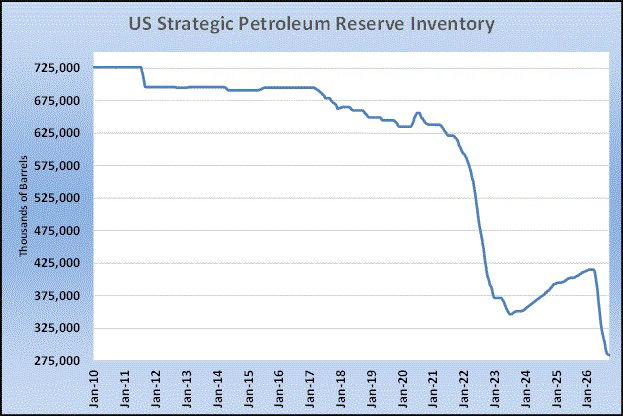
U.S. strategic reserves were drawn down at the start of the Russia-Ukraine war. They recovered briefly but began declining again after the U.S.-Iran war began. Draws from the U.S. Strategic Petroleum Reserve have slowed recently. In fact, in July the U.S. offered the last 40 million barrels of a 172-million-barrel release. Only 500,000 barrels of that offering were accepted. With the administration desperate to get prices down before the midterm elections, it is reoffering that 40 million barrels this month.
This summer, with crude and refined fuels inventories falling globally, prices rising and Iran showing no sign of capitulation, the United States shifted its focus from getting Iran to abandon its nuclear program to winning the battle for the Strait of Hormuz. Military operations became focused on degrading Iran’s ability to monitor and attack shipping on the Strait of Hormuz. The U.S. military also cleared mines and developed an escort system to move ships through the strait.
Those efforts took a while to take hold, but they are beginning to do so, perhaps marking the end of the beginning of the war. The United States initially escorted tankers with transponders turned off through the strait at night. Convoys are now moving during the day as well. Saudi Arabia and other Persian Gulf producers are running the strait under escort and then transferring their cargo to ships waiting on the other side. Ships are still unwilling to risk going through the strait.
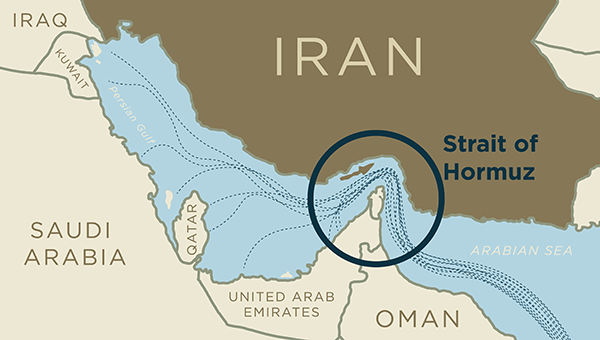
Throughout September, there were reports that export volumes from the Middle East were dramatically increasing – not only because of the U.S. escort system through the strait but also because of the use of pipelines to avoid the Strait of Hormuz altogether. Goldman Sachs reported that over the past week, it estimated that from all routes and options, over 23 million barrels per day of crude moved out of the Middle East. That is comparable to prewar levels.
If these estimates are indeed true and they continue, Iran has lost its key leverage in negotiations. To its credit, the administration has adapted and waited for the new strategy of defeating Iran economically to take hold. It put a naval blockade on Iranian shipping and tightened sanctions on any country aiding Iran and buying its crude. This caused countries that had been vital for Iranian trade, like the United Arab Emirates, to sever ties with the Islamic regime.
Inflation is rampant in Iran. Its rial is now worth 0.00000057 U.S. dollars. That means one U.S. dollar is worth around 1,747,044 rials. The country is said to be running out of many basics, including water. By losing its grip on the Strait of Hormuz, the Iranian regime has lost its only leverage for dictating terms for ending the war. The United States appeared willing to accept weaker terms throughout the summer, but Iran kept overplaying its hand. The United States has recently been rejecting Iran’s proposals for ending the war and recently sent its delegation home from New York, saying it had overstayed its welcome. That sent a clear message that the United States knows it has all the leverage now.
The United States has also continued to ramp up its military capabilities in the region. Another amphibious assault group is headed to the region along with a third carrier strike group. That will put U.S. forces in the region at 60,000. It should be a signal to Iran that the United States is playing the long game. The United States appeared a little flatfooted when the war turned into the battle for the Strait of Hormuz, but it is showing it will not be caught without the resources needed to protect the strait going forward.
In the early stages of World War II, the political pressure on Churchill to seek a negotiated peace with Germany was tremendous. At the time, the terms of that peace would not have favored Great Britain, as Germany had all the leverage. To his credit, Churchill held steadfast, and after much sacrifice by his nation and others, Germany had to surrender unconditionally.
There’s been a great deal of political pressure on President Trump and the Republican Party to end the war with Iran. There seems little doubt, if polls can be believed, that Republicans will lose control of one or both branches of Congress in November. There is little doubt Trump would have ended the war sooner, so the fallout from it would not have been so politically damaging if Iran had been reasonable. But one must give him credit now that he appears to have the leverage over Iran and is not willing to squander it. He is conceding that he will have to wait until after the midterm elections to get the outcome he seeks in the war, which is no nuclear program in Iran.
Churchill knew in May 1943 that much more would have to be sacrificed before Germany could be defeated. Thus, his warning that the end of the war was not even in sight despite the victory in Africa. President Trump appears willing to accept the political defeat that is likely to come in November to get the terms he desires in Iran. That is not common in politics these days.
One may argue that Trump should never have begun Operation Epic Fury against Iran. Given the political risks that Trump had to have certainly known existed if he did attack Iran, it seems the odds are he had a genuine belief that ending Iran’s nuclear threat had to be done immediately. Perhaps he thought before the war began that it would end quickly and be positive rather than negative politically. But history has shown that in no other human endeavor do expectations and reality diverge as much as they do in war. Surely Trump understood things might not go according to plan, as is almost always the case with war.
Even if one does not agree with the war, it would be hard not to give some credit to the administration and military leadership for changing strategies, being patient while putting the pieces in place to ensure the new strategy worked and then fully leveraging the new strategy’s success.
Relief from high prices may still be a ways off for U.S. consumers, and voters always punish whichever political party they deem has hurt their pocketbook. But at least it now feels like the sacrifices everyone has made could lead to the United States ending the war with Iran on positive terms for the United States – positive from both an energy security and national security standpoint.
To subscribe to LP Gas’ weekly Trader’s Corner e-newsletter, click here.
You May Also Like
-

Propane market outlook
Sep 28, 2026 -
European natural gas inventories fall below normal
Sep 21, 2026 -
Strong run in propane prices
Sep 14, 2026




Subscribe to LP Gas
If you enjoyed this article, subscribe to LP Gas to receive more articles just like it.