


Propane inventories fall as summer ends
Trader’s Corner, a weekly partnership with Cost Management Solutions, analyzes propane supply and pricing trends. This week, Mark Rachal, director of research and publications, explores how rising domestic and foreign demand is making propane inventories fall.
Catch up on last week’s Trader’s Corner here: Propane inventories break record high
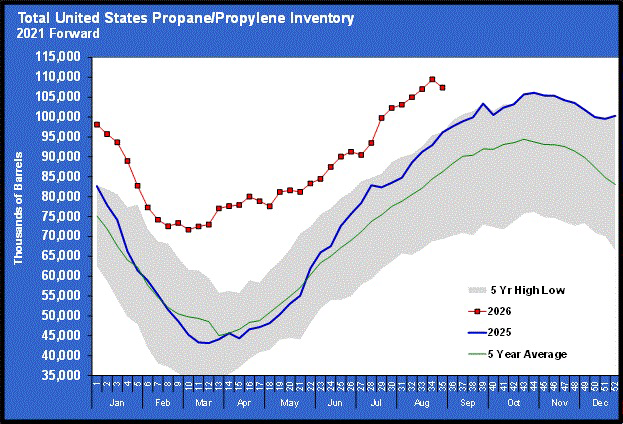
There has been a remarkable run higher in U.S. propane inventories this summer, especially in the latter half of summer. As a result, U.S. propane inventories set a new record high of 109.483 million barrels for the week ending Aug. 8. The buildup of inventory has surprised many (us included), as we expected the Middle East supply disruption to increase foreign demand and hold builds down.
But as the saying goes, all good things come to an end. That saying is a reminder that nothing lasts forever and encourages us to appreciate the good moments while they last. This feels like one of those situations.
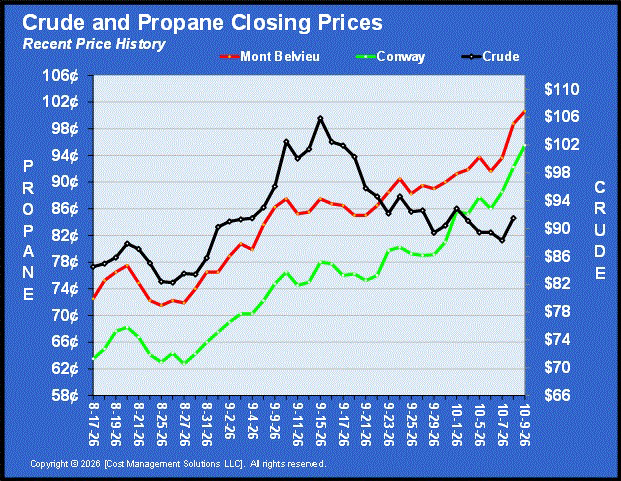
The Energy Information Administration (EIA) reported a 2.072-million-barrel draw in propane inventories in a week that has averaged a gain of 2.208 million barrels over the last five years. That is about a 4.3-million-barrel departure from normal, so it was not an insignificant amount. Not surprisingly, propane markets reacted with a rebound in pricing.
For the week, both exports and domestic demand increased, resulting in the call on inventories.
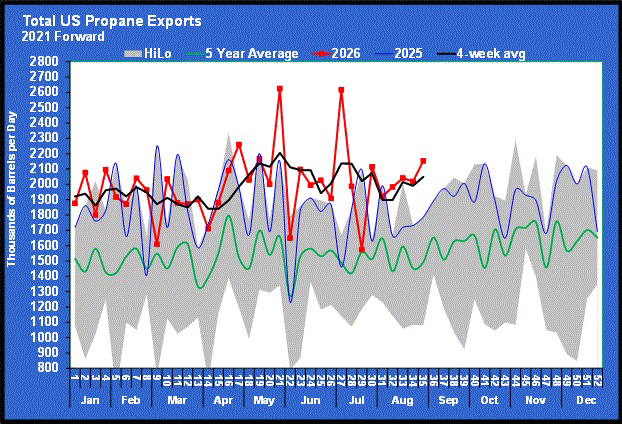
There is no doubt foreign demand has had an impact. Propane exports have been setting new five-year highs almost all summer. It appears that export capacity limitations constrained exports despite high demand. Some of those constraints will be removed before the end of the year with new capacity coming online.
But this past week, an increase in domestic demand was the primary catalyst that reversed the trend in propane inventories from increasing to decreasing.
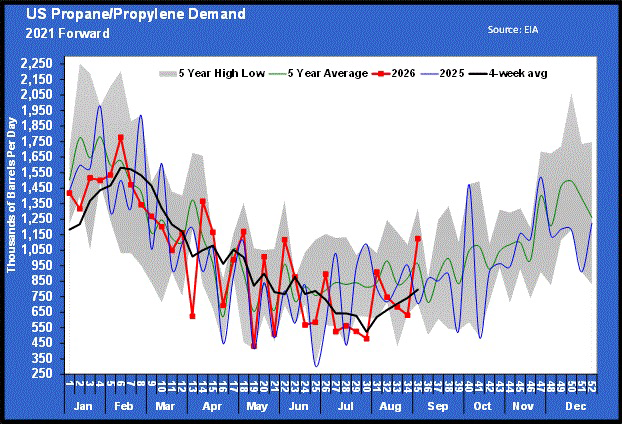
U.S. domestic demand jumped last week from 631,000 barrels per day (bpd) to 1.125 million bpd, a 494,000-bpd increase.
You will recall that in July, when domestic demand was setting five-year lows, we wondered if normal summer filling was being delayed, with most people expecting the war between the United States and Iran to end, which would likely result in a fall in propane prices. We still believe that was probably the case. More recently, though, it has become apparent that the war between the two countries, which has disrupted energy supplies since February, is unlikely to end anytime soon.
The United States recently shifted its focus from military attacks to economic strangulation on Iran – a strategy that certainly shows signs of being effective. Yet, it is a strategy that will take time to achieve the outcome the United States is hoping for in negotiations. We wonder if buyers finally just threw in the towel and stepped in for winter supply, given the lower probability that pricing would dramatically change before winter with the new U.S. strategy coming to light.
It is the time of year when domestic demand begins to increase, so the upswing is not surprising. The only surprise was how significantly demand increased during the week ending Aug. 28. We can write it off as typical week-to-week volatility in the demand numbers that seem to be more report-related than actual shifts in demand.
Remember, the EIA calculates domestic demand. No one sends reports on domestic demand that the EIA uses to calculate its domestic demand number. Instead, the EIA calculates what domestic demand must have been when considering production, imports, exports and inventory changes. The EIA does get reports on all those data points from which to derive its numbers.
In this case, though, we are pulling for the uptick in domestic demand to be factual. Hopefully the big demand increase was not a reporting anomaly but a real increase in demand. It would be far better to see consumers getting active now while temperatures remain high than a sudden surge in domestic demand at the first notable winter weather event. We would consider consumers waiting to fill their tanks for winter a bad thing for our industry that could test logistical constraints.
It was discouraging in a way, when you pull for propane buyers as we do, to see the upward trend in inventories reverse. But on the other hand, when we allowed ourselves to believe it meant consumers were finally getting positioned for winter, it was a good thing.
We are almost certain to see an upswing in propane exports later this year as more export capacity comes online. The last thing we need is for an excessive amount of domestic demand to hit at the same time. So, we are definitely pulling for last week’s draw on inventories to be the result of a real increase in domestic demand, not a reporting blip.
Charts courtesy of Cost Management Solutions.
To subscribe to LP Gas’ weekly Trader’s Corner e-newsletter, click here.
You May Also Like
-
Propane price spreads encourage exports
Oct 19, 2026 -
Propane prices, valuation shifting
Oct 12, 2026





Subscribe to LP Gas
If you enjoyed this article, subscribe to LP Gas to receive more articles just like it.