


Record-high crude production
Trader’s Corner, a weekly partnership with Cost Management Solutions, analyzes propane supply and pricing trends. This week, Mark Rachal, director of research and publications, explores the factors surrounding U.S. crude production reaching its highest level ever.
Catch up on last week’s Trader’s Corner here: The dynamic that’s drawing down Midwest propane inventories
When the Energy Information Administration (EIA) released its Weekly Petroleum Status Report for data it had collected on Oct. 30, it showed U.S. crude production at its highest level ever. The EIA estimated U.S. crude production at 14.003 million barrels.
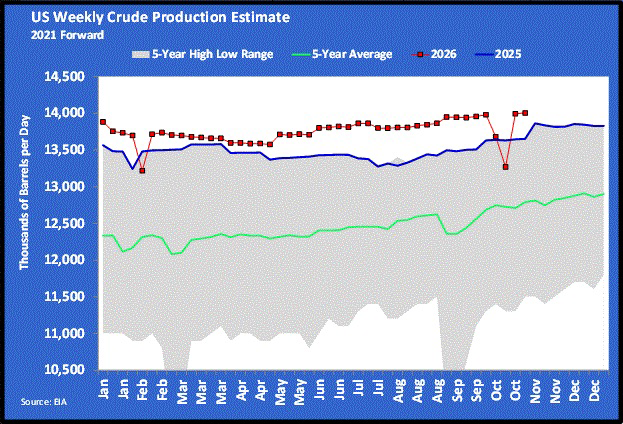
Production temporarily dipped in October because of a hurricane but came roaring back over the last two weeks.
The number reported in the Weekly Petroleum Status Report is an estimate. The official production number will not be out for a couple of months. We may find out then that production was shy of the estimate. But that does not take away from the fact that U.S. crude production is at its highest level ever.
Because propane is a natural gas liquid, many mistakenly believe propane only comes from natural gas wells. A lot of propane does come from what are classified as natural gas wells, which are those that produce mostly light hydrocarbons. Crude wells are those that produce heavy hydrocarbons, but they also produce a lot of light hydrocarbons.
Some of the light hydrocarbons produced with crude stay stuck in the heavier hydrocarbons and are not separated until the crude is refined. Only about 10 to 11 percent of U.S. propane supply is yielded during refining operations.
The bulk of the light hydrocarbons produced along with the heavy hydrocarbons of a crude well are separated in the field and then get commingled with other light hydrocarbons in gathering systems that take them to fractionators rather than refineries. Nearly 90 percent of U.S. propane supply comes from these fractionation operations. But the fact is, a lot of the hydrocarbons being fractionated originated from heavy hydrocarbon or crude wells.
When U.S. crude production was lower and the country imported most of its crude, there was no opportunity for associated natural gas and natural gas liquids production. Only the light hydrocarbons trapped in the heavier hydrocarbons that get separated at the refinery become available to propane retailers and their customers.
When we first started writing Trader’s Corner, U.S. crude production was only averaging 5 million barrels per day (bpd), and the United States was a net importer of propane. Propane from refineries was a much larger portion of U.S. propane supply back then.
We often hear that the United States is energy independent. That is a bit misleading. When you consider the entire hydrocarbon picture, it may be true that we are a net exporter of hydrocarbons because of all the natural gas and natural gas liquids that we export. But we are still a net importer of crude.
The United States consumes about 21 million bpd of petroleum products – those made from crude. Currently, we are refining about 16.725 million bpd of crude. Believe it or not, a barrel of crude yields more than a barrel of refined products. The weight of the refined fuels and the crude is the same, but the volume of product increases. A 42-gallon barrel of crude yields about 45 gallons of refined products.
Last week, refiners processed 16.725 million barrels of crude, which yielded around 17.895 million barrels of refined fuels. Still, that was short of last week’s total petroleum products consumption. Last week, there were 21.962 million barrels of total petroleum products consumed, meaning the United States needed to import and draw from inventories around 4 million bpd of refined products.
Also, even at 14.003 million bpd of crude production, the United States had to import or draw from inventories totaling 2.722 million bpd of crude.
Chart 2 shows the difference between production and refinery throughput.
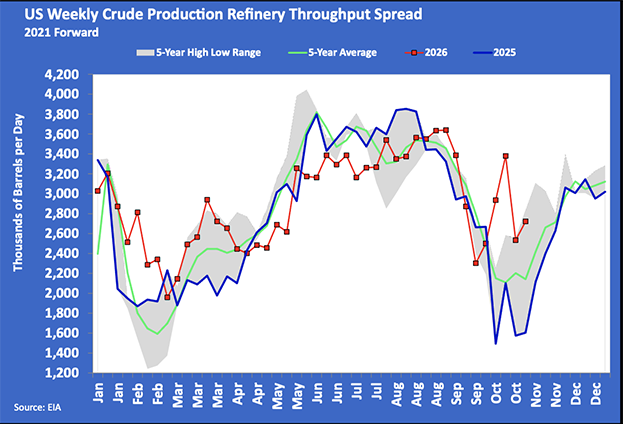
The positive number above represents the amount of crude the United States must import or pull from inventories for its refineries. Still, the amazing growth in U.S. crude production of about 9 million bpd has been a key contributor to propane production going from 1.1 million bpd when we started writing Trader’s Corner to 2.948 million bpd now.
We also export crude. The United States is net long light crude and is net short heavy crude. The important number is the difference.
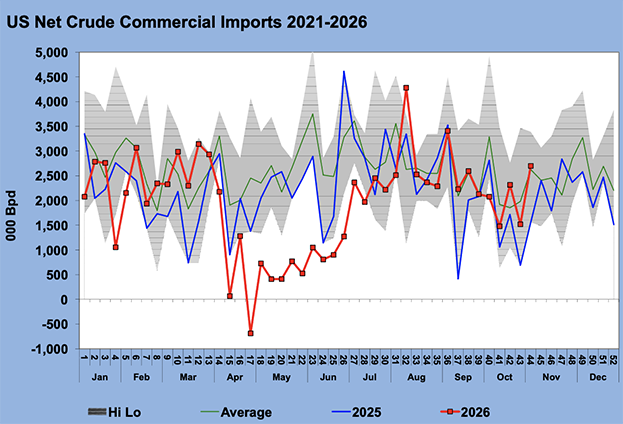
Chart 3 shows net crude imports (imports minus exports). We remain dependent on foreign supplies of crude. The good news is that our imports are primarily from Canada and Venezuela. The supply situation from Venezuela has recently taken a major turn for the better. The United States has a deal that could see as much as 67 billion barrels of crude exported from Venezuela to U.S. companies over the life of the deal. U.S. companies will invest in improving Venezuela’s crude production, and the crude will be exported to the United States. This deal solves a shortfall of heavy crude for the United States.
While the United States is still a net importer of crude despite its record production, its imports come from relatively friendly sources with little chance of the distribution being blocked or disrupted. The crude from Canada is shipped via pipeline. The supply from Venezuela will be via tanker, but the U.S. Navy is in a position to protect those shipping lanes. Also, Canada is the second-largest importer of U.S. crude, making the two countries interdependent and making the supply even more secure. We expect light crude exports to Venezuela could be increasing in the future.
The U.S. crude position, and by extension, North and South America’s crude supply position, is far more secure than Europe and Asia.
Once the U.S.-Iran war ends, which will probably occur in the next couple of months, Iran will be in the position to threaten supplies to those areas of the world. European countries have said that once there is a peace agreement between the United States and Iran, they will protect shipping in the Strait of Hormuz. We do not think the war will end with a peace agreement being signed. Instead, we think the United States will declare Iran’s nuclear capability destroyed and simply leave. After that, European and Asian countries, along with Persian Gulf producers, will be left with either paying Iran to use the Strait of Hormuz or protecting their ships themselves.
Charts courtesy of Cost Management Solutions.
To subscribe to LP Gas’ weekly Trader’s Corner e-newsletter, click here.
You May Also Like
-

El Niño in play for the 2026-27 winter
Oct 26, 2026 -
Propane price spreads encourage exports
Oct 19, 2026


About the Author: Chris Markham
Chris Markham is the managing editor of LP Gas Magazine. Contact him at cmarkham@northcoastmedia.net or 216-363-7920.


Subscribe to LP Gas
If you enjoyed this article, subscribe to LP Gas to receive more articles just like it.