


The dynamic that’s drawing down Midwest propane inventories
Trader’s Corner, a weekly partnership with Cost Management Solutions, analyzes propane supply and pricing trends. This week, Mark Rachal, director of research and publications, explains his concern about low Midwest propane inventories.
Catch up on last week’s Trader’s Corner here: El Niño in play for the 2026-27 winter
In the Trader’s Corner a couple of weeks ago, we looked at the high spread between U.S. propane prices and overseas propane prices. That spread has developed because a key source of global propane supply is the Middle East, and that source has been cut off since the war between the United States and Iran began.
Consequently, buyers are turning to the United States, which increases the ratio of buyers to sellers in the U.S. market. We can almost forget propane fundamentals in this case. An increase in buyers relative to sellers is almost always going to put upward pressure on prices regardless of reason.
More recently, we have learned that there is high domestic demand for butane, which is limiting the amount of butane available for export. As a result, there is more room on tankers to carry propane, which further increases offshore buying. This leaves U.S. propane retailers competing with a growing number of offshore buyers for the available propane supply.
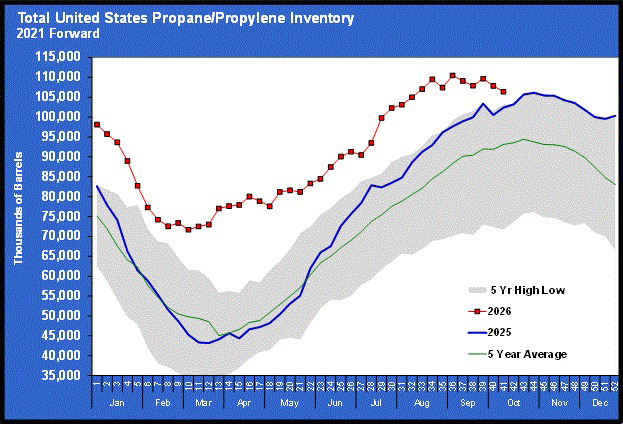
The increased export demand has caused last year’s propane surplus to evaporate in relatively short order.
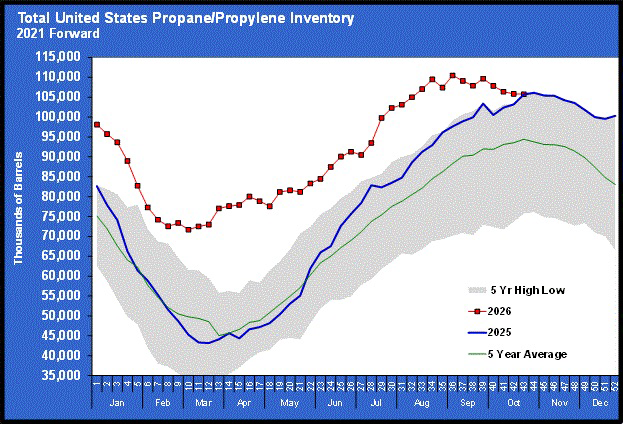
To be sure, total propane inventory is still high and setting a record high for this time of year, still above the inventory from this time last year by 54,000 barrels. Still, the market is trading based on the trend, where it appears inventories are headed, rather than their current position.
There is an area of the United States where inventories are not so good and appear to be where overall inventories may be headed. Midwest propane inventories are on a trajectory to set new five-year lows very soon.
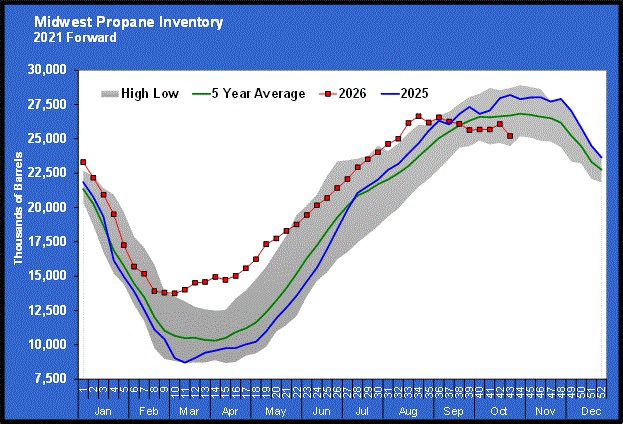
We don’t really think of the Midwest as an export market. While it may not export directly to overseas markets, the Midwest inventory does export to other regions of the United States, where that propane can then access foreign buyers.
Just like the spread between Mont Belvieu propane and foreign markets we visited two weeks ago, there can be price spreads between regions of the United States that encourage movement between the regions.
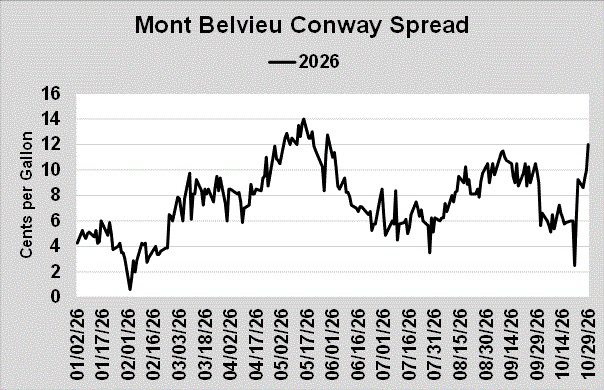
Chart 3 shows the price difference between Mont Belvieu ETR propane and Conway, reflecting the premium that ETR holds over Conway.
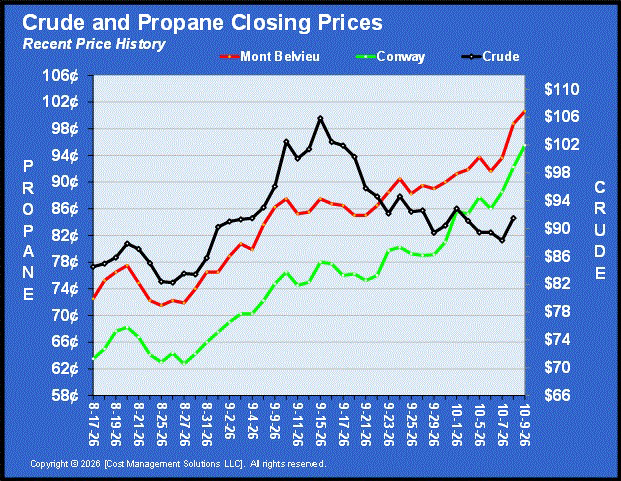
In 2025, MB ETR held an average premium of 4.7018 cents to Conway. It usually takes a 5-to-6-cent difference to cover the cost of moving Midwest propane to the coasts where it can reach export markets. When domestic demand gets high, that spread will fall well below that number, and in some cases, Conway will even hold a premium to MB. Midwest producers store production so they can capture the winter premium.
But the spread between the U.S. market and foreign markets has gotten so high that Midwest producers can make more by paying the cost to move their production to the coasts for export. On the morning we are writing this article, Far East propane is valued 85 cents and Europe 43 cents above MB ETR. So even with the 5 or 6 cents it takes to move Midwest propane to the coast, there remains plenty of spread to make money exporting.
It appears that Midwest producers are willing to take the bird in the hand (the high return for exporting) rather than the potential return when Midwest heating demand picks up.
For all of this year, the MB premium has been 7.6268 cents, and since August, when we see Midwest inventories turning lower, the spread has been 8.3413 cents. The higher the spread, the greater the incentive for Midwest producers to move their production to the coast.
Again, normally at this time of year, the gap between MB and Conway pricing would be narrowing, not expanding. But all the propane moving out of the coasts to foreign markets is creating a vacuum that is sucking propane from the Midwest as well.
This makes Midwest propane retailers and their customers that are dependent on local supplies to meet winter heating demand very vulnerable. When domestic demand kicks in, the only possible outcome is for Conway pricing to increase relative to Mont Belvieu and, by extension, the global propane market.
That means as this winter moves forward, there is increased potential to see a rapid rise in Conway propane prices. To make the situation more precarious, the opportunity to source propane via rail from Canada might be a limited and pricey option as well.
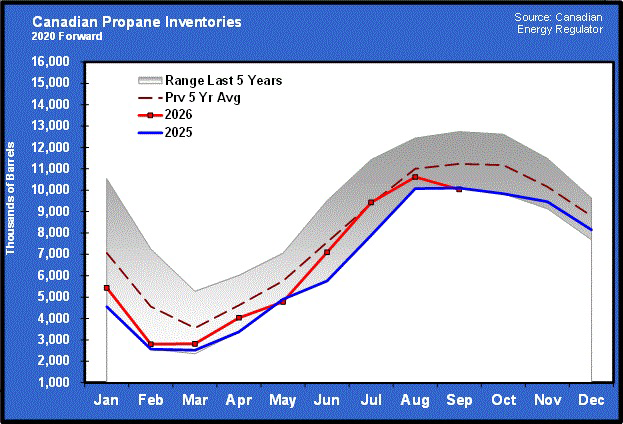
Canada’s propane inventories took a surprisingly large drop in September, sitting at a five-year low at the end of the month. We suspect Canadian producers have been chasing the same opportunities to export that U.S. producers have been chasing.
Midwest propane retailers need to be aware of the position we are in here. Obviously, keeping plenty of physical supply on hand and encouraging customers to do the same seems prudent. We recognize that is a hard sell with prices elevated over last year.
Hedging or getting price protection might seem logical, but doing too much too far out has a lot of risk as well. Who knows what will happen with the war between the United States and Iran after the midterm elections? The United States is said to be planning to resume military operations. Perhaps that will be enough to bring the war to an end, but perhaps not.
If one is inclined to do something to protect against higher prices, it would probably be best to take shorter-term positions. It truly is a hard call here, but significant upside price risk is present and, perhaps more importantly, supply could be hard to come by at times. So, get ahead of your physical supply as best you can and hope the worst in terms of pricing doesn’t occur.
Charts courtesy of Cost Management Solutions.
To subscribe to LP Gas’ weekly Trader’s Corner e-newsletter, click here.
You May Also Like
-
El Niño in play for the 2026-27 winter
Oct 26, 2026 -
Propane price spreads encourage exports
Oct 19, 2026 -
Propane prices, valuation shifting
Oct 12, 2026

About the Author: Chris Markham
Chris Markham is the managing editor of LP Gas Magazine. Contact him at cmarkham@northcoastmedia.net or 216-363-7920.


Subscribe to LP Gas
If you enjoyed this article, subscribe to LP Gas to receive more articles just like it.