


How propane retailers can capitalize on growing demand for energy resilience
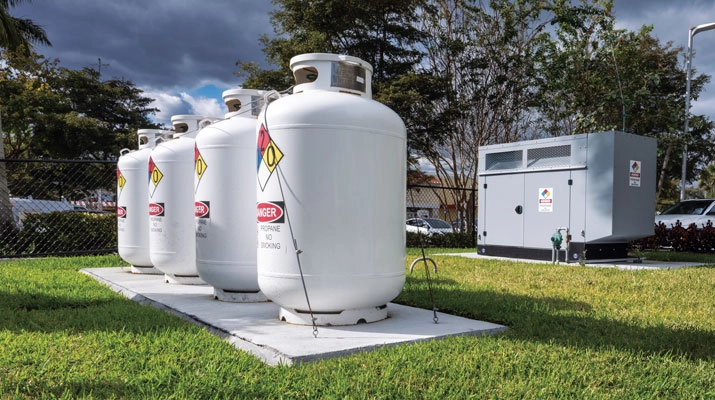
The propane industry has spent years making the case for reliable, on-site power. Today’s customers seem finally ready to listen.
An aging grid, rising utility rates, severe weather and accelerating demand are changing how customers now think about energy. Resilience and speed of deployment have moved to the front of the conversation, creating an opening for propane across applications ranging from residential standby generators and mobile rental units to combined heat and power (CHP), fuel cells and prime-power systems.
For propane retailers, however, the opportunity will not be captured simply by having fuel available. Success requires a shift from responding to generator-fill requests to helping customers assess loads, select equipment, size storage, plan delivery and maintain systems over the long term.

“We’ve got to be the solution,” says Chris Hill, president and CEO of San Antonio-based Meritum Energy. “Let’s not turn the market away by saying ‘no’ to it or not being able to meet its needs.”
That was a central message at the Propane Education & Research Council’s (PERC) Power Generation Summit earlier this year. The event brought marketers together with about 15 original equipment manufacturers. Retailers gained a clearer view of available equipment, while manufacturers saw evidence that the propane industry intends to build a market for it.
“It demonstrated to the manufacturers that the propane industry is making a go at this, so we better have the equipment necessary,” says Bert Warner, PERC’s director of commercial business development. “It put confidence in them that they need to invest to make sure these pieces are available to us.”
▶ A market ready to listen
The immediate catalyst is not any single technology or customer class. There is widespread uncertainty about whether the grid can deliver enough affordable, reliable electricity when customers need it.
Warner notes roughly 75 percent of participants in his webinars typically report experiencing an outage within the previous 12 months. When asked about their confidence in the grid’s future, the share expressing concern rises to about 90 percent.
“Even if they haven’t experienced it themselves, they believe we’ve got problems ahead and need to look at things,” Warner says. “The doors are open now to have those conversations, and everybody is hungry for answers.”
Propane can be deployed much faster than new transmission infrastructure, stored on-site and scaled to the application. It can provide standby power, prime power or support a hybrid strategy that reduces peak demand and time-of-use charges.
Jeff Stewart, president and CEO of Santa Rosa, California-based Blue Star Gas, sees electrification pressure as both a threat to traditional propane loads and an invitation to marketers to diversify.
His company created a dedicated power generation division about five years ago. It begins customer evaluations with utility bills, time-of-use rates, demand charges and the facility’s thermal and electric loads.
“Consumers are absolutely unaware of the role propane can play, so the first step is to educate and inform,” Stewart says. “Then we do an analysis to determine whether they are candidates for propane-powered prime generation.”
The widening equipment portfolio strengthens that proposition. Diesel once had much of the generator market to itself, but manufacturers now offer far more propane options.
“We have a lot more commitment from the engine manufacturers and generator packagers putting products into the market,” says Hill, who also chairs PERC. “Between product availability and the fuel characteristics and costs, it is a natural fit.”
▶ Choose the right entry point
The breadth of the market can be energizing, but it can also tempt retailers to chase projects that do not fit their capabilities. The better starting point is often the customer list they already possess.
Warner urges marketers to ask propane customers what they would do during an outage and what fuel supports their backup equipment. A diesel generator installed at a propane-served home or business represents a missed burner tip that might have been prevented through an earlier conversation.
Residential standby remains a familiar entry point. Moving space heating, water heating, cooking and clothes drying to propane reduces a home’s electrical load and the generator capacity needed to support it.
Light commercial applications may offer an especially practical next step. Hotels, assisted-living and memory-care facilities, breweries, restaurants and other operations with steady hot water requirements can be strong candidates for CHP. Instead of discarding an engine’s exhaust heat, CHP captures it for water heating or other thermal needs, lifting total system efficiency well beyond electricity generation alone.
“An internal combustion engine producing electricity by itself is about 30 percent efficient,” Stewart says. “You have to capture the heat to get the efficiency up, and with CHP you can achieve 75 percent to as high as 93 percent, depending on the product and how thoroughly the heat is captured.”
You May Also Like
-

Basin Coop acquires Inter-Mountain Propane
Sep 17, 2026 -

How to hire for safety in the propane industry
Sep 17, 2026



Subscribe to LP Gas
If you enjoyed this article, subscribe to LP Gas to receive more articles just like it.