


Impacts of US-Iran conflict on propane market
Trader’s Corner, a weekly partnership with Cost Management Solutions, analyzes propane supply and pricing trends. This week, Mark Rachal, director of research and publications, explains how the current conflict between the United States and Iran is impacting the global propane market.
Catch up on last week’s Trader’s Corner here: Making sense of volatile crude inventories
The Energy Information Administration (EIA) released its latest Weekly Petroleum Status Report on Wednesday, March 4. The data for that report was collected on Friday, Feb. 27.
Operation Epic Fury by the coalition of the United States and Israel against Iran began on Saturday, Feb. 28. Therefore, nothing about that event was reflected in the EIA’s latest data. However, if the conflict between the United States/Israel and Iran continues, there will continue to be impacts on the U.S. propane market, and we should see data changes in the Weekly Petroleum Status Report as a result.
From an energy standpoint, the biggest impact of the conflict has been the closing of the Strait of Hormuz off the southern coast of Iran. The Strait of Hormuz is a narrow passage of about 25 miles for deep draft ships. While the strait is not technically closed, it is not being used because Iran still could attack shipping that tries to run through it.
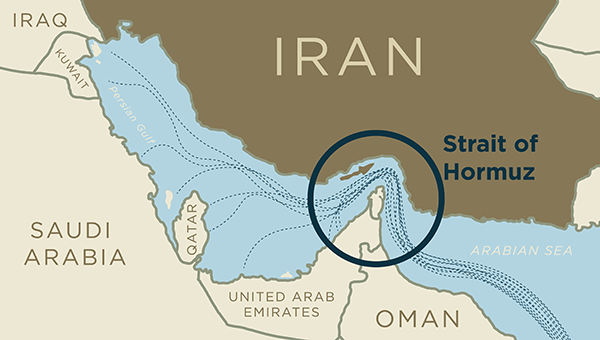
Iran’s navy has been destroyed, so direct attacks are unlikely. However, Iran still has the capability to launch missile and drone attacks against shipping from remote bases. Therefore, ship crews are not willing to risk their lives to go through the strait, nor are companies willing to risk valuable assets. Insurance companies notified companies that they had dropped war-related coverage if the loss occurs around the Strait of Hormuz.
In response, President Donald Trump instructed the U.S. Development Finance Corp. to provide, at a reasonable price, political risk insurance and guarantees for the financial security of maritime trade, especially energy, traveling through the Persian Gulf and the Strait of Hormuz as soon as possible.
Later, the president said he would make the U.S. Navy available to escort ships through the strait and would provide for their defense. But to this point, the quantity of missiles and drones being deployed by Iran greatly increases the odds that one will get through, even against the best defense.
That means for the price of energy to come down, one of three things must occur. The United States must eliminate Iran’s ability to attack shipping; the United States must further degrade Iran’s attack capabilities, provide insurance for ships and provide escorts for protection; or the hostilities must end. The United States still has a way to go to completely neutralize Iran militarily, and Iran is showing no signs that it is willing to capitulate. That leaves the second possibility the most likely in the short term.
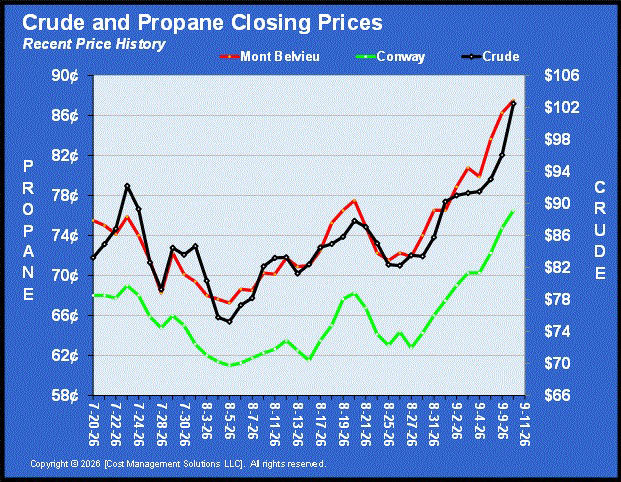
Even though there has been no data to support higher propane prices, they have been going up because of rising crude prices and because of the threats to supply.
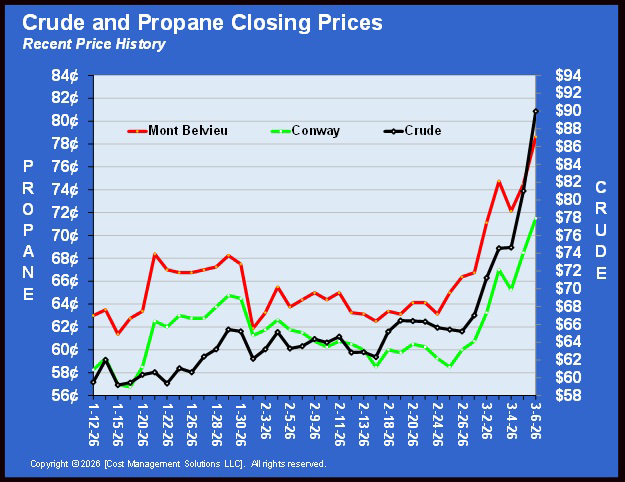
Both crude and propane prices were on the rise in response to the tensions between the United States and Iran that increased the likelihood of war, but the upward momentum has surged since the conflict began.
Crude is up $22.95 per barrel from the day before the conflict to when we are writing on Friday, March 6. That is a 34 percent gain. Propane has significantly lagged crude with a gain of 11.875 cents per gallon at Mont Belvieu and 10.75 cents per gallon at Conway. Those are both 18 percent gains.
Even though supply from the Middle East is threatened, the price spread between U.S. propane and foreign markets has only gone up slightly.
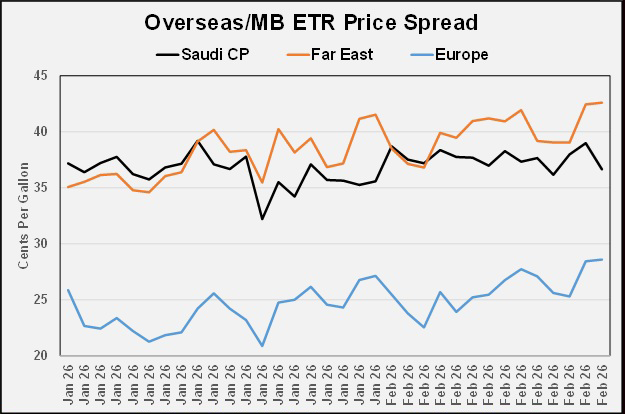
So far, it has been a “rising tide lifts all ships” situation.
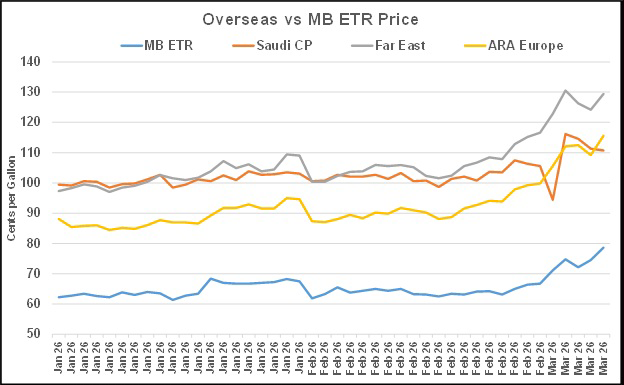
The odd dip in Saudi CP was not related to the conflict. It occurred a couple of days before Operation Epic Fury began and was related to issues with an export facility.
However, we are just now getting to the point where energy supplies are being impacted. Middle East producers are being forced to shut production as they run out of storage, with ships unable to move through the Strait of Hormuz normally. Globally, refineries are starting to adjust as supplies tighten. China has forbidden its largest refineries from exporting refined fuels to conserve supplies for domestic use.
One would expect that as supply issues elsewhere mount, the call on U.S. propane will increase. However, last week, U.S. propane exports took a nosedive, resulting in propane inventories increasing.
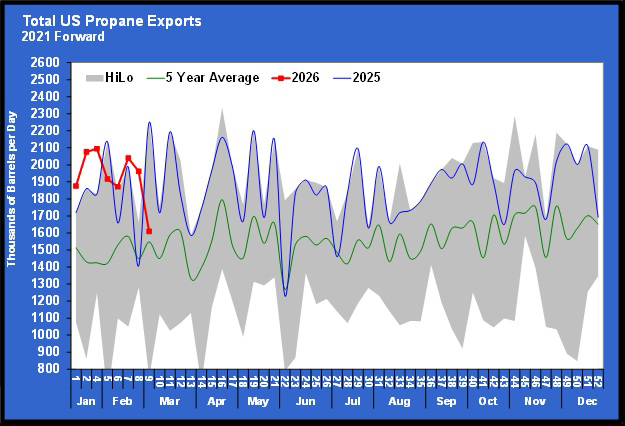
As we said, this data was collected before the operation began, so the decline was due to some other reason. Overall, exports are volatile, so we chalk the dip up to that alone. But if the conflict drags on, we would expect propane exports to rebound, possibly next week, and stay high until shipping companies and crews feel safe passing through the Strait of Hormuz.
Even so, U.S. propane inventories are insanely high, and it’s going to take exports at sustained high rates for a long time to make much of an impact. Regardless of global demand, U.S. export capacity is constrained. That means the worst-case scenario is that export rates run consistently near the spikes above for a while.
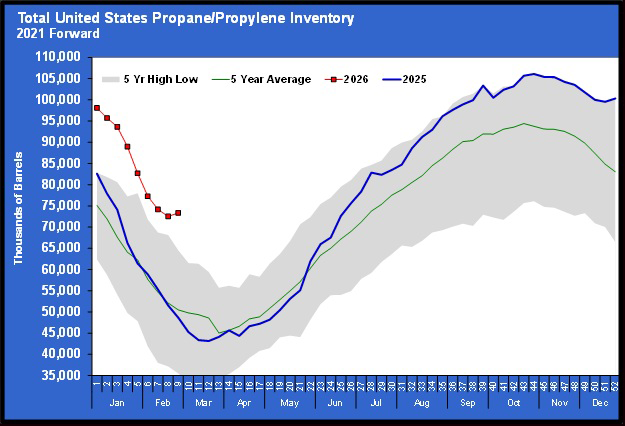
Given the level of inventory, it is going to take exports at maximum rates for a while to make a lot of difference. The highest daily export rate in a single week was 2.335 million barrels per day. It is highly unlikely that kind of rate could be sustained day after day for an extended period.
However, the conditions are certainly set for exports to go up significantly from last week. We believe that calls on U.S. propane inventories could resume despite last week’s very early build. We should expect higher propane prices to continue until ships loaded with crude and LNG are once again moving through the Strait of Hormuz. That crude and LNG in those ships contain propane, and until it can be moved to a place where it can be processed, it will be lost to the global market.
Charts courtesy of Cost Management Solutions.
To subscribe to LP Gas’ weekly Trader’s Corner e-newsletter, click here.
You May Also Like
-
Strong run in propane prices
Sep 14, 2026 -

How LP Gas continues to raise the bar on coverage
Sep 10, 2026



Subscribe to LP Gas
If you enjoyed this article, subscribe to LP Gas to receive more articles just like it.