


Global demand increases for US propane exports
Trader’s Corner, a weekly partnership with Cost Management Solutions (CMS), analyzes propane supply and pricing trends. This week, Mark Rachal, director of research and publications, reports on the rising demand for U.S. propane exports.
Catch up on last week’s Trader’s Corner here: The US-Iran war’s effects on propane: A recap
Since the U.S.-Iran war began, U.S. propane prices have tended to lag gains in crude prices. However, that tendency changed this past week.
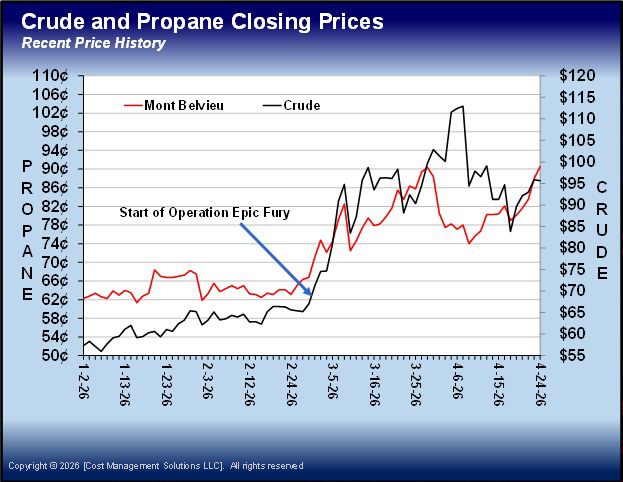
Operation Epic Fury launched on Feb. 28. Propane at the Mont Belvieu Energy Transfer (MB ETR) pricing point had closed on Feb. 27 at 66.75 cents. WTI crude closed that same day at $67.02. At that point, MB ETR propane was trading at 42 percent of the value of a barrel of crude.
From that point, propane lagged crude’s gain. By early April, propane prices were falling, while crude prices were surging. As a result, MB ETR propane was valued at just 29 percent of the value of WTI during the first week of April.
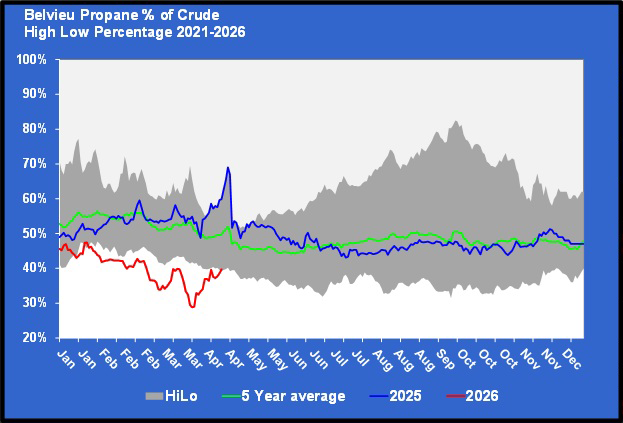
However, in the last couple of weeks, things have started to change. For a week, propane prices went up, while crude prices went down. Then over the last week, propane ran higher with crude and finally surged on April 23. As we write on April 24, propane is up, while crude is down on the day.
It begs the question as to what has changed over the last couple of weeks.
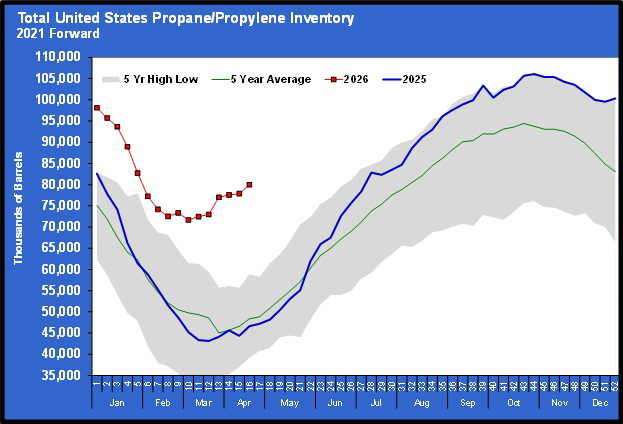
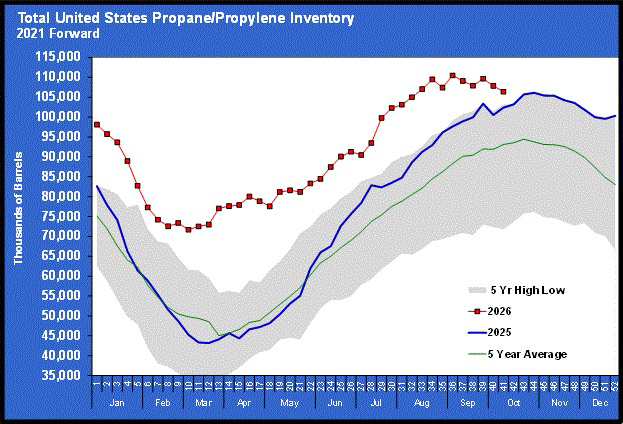
What has not changed is the fact that the United States is oversupplied with propane. Propane inventory is easily setting new five-year highs for this time of year. Propane production recently set a record at 3.028 million barrels per day (bpd) during the first week of April and is currently just under 3 million bpd. U.S. domestic demand has averaged 963,000 bpd over the last four weeks – less than a third of production. It was down to 694,000 bpd this past week.
Since the war between the United States and Iran began, we have been predicting propane exports to climb to their maximum rate and stay there until the conflict ends. However, that prediction had not come to fruition until this past week.
U.S. export capacity is between 2.2 and 2.3 million bpd. The highest export rate the Energy Information Administration has ever reported was 2.335 million bpd during one week of April 2025. But in practical terms, the maximum sustainable rate of exports is probably closer to 2.1 million bpd, and that would be a major challenge for the propane export facilities. A lot would have to go right to sustain that level day in and day out. For all of last year, the export rate was 1.862 million bpd, and so far this year, it has been 1.913 million bpd. During the eight weeks that propane supplies from the Middle East have been impacted by the war, the U.S. export rate has been 1.872 million bpd. This past week, the export rate was 2.09 million bpd.
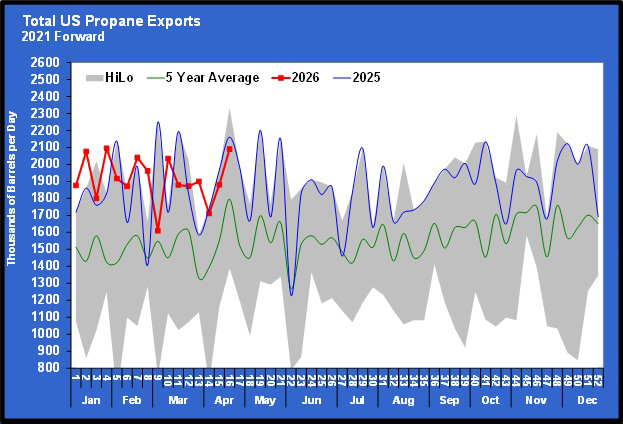
As Chart 4 shows, it is not unusual for propane exports to be high during the latter part of April. Propane markets are reacting as if the export rate is going to stay at this level or higher going forward. Perhaps our prediction of maximum, sustainable export rates is finally coming to fruition.
Perhaps it’s not. As Chart 4 shows, it is hard for export rates to stay at last week’s level for a sustained period. If they do, it will be something we have not seen.
Interestingly, the spread between the U.S. market and the Asian and European markets has been narrowing since surging in the first few weeks of the war.
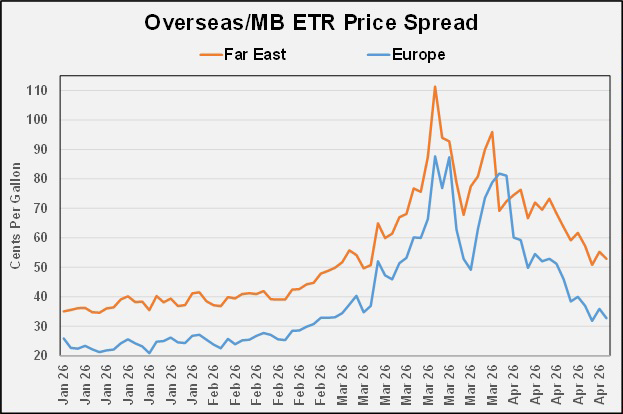
Perhaps the delay in maximizing U.S. exports is just a matter of logistics. Buyers of Middle East propane would pay more shipping costs to use U.S. propane, so there is a natural resistance to avoid it if possible. Many would have held off, hoping the war would end relatively quickly and their natural market would be available to them again. The messaging from the United States was certainly pointing in that direction.
But as the war has dragged on, importers of propane are probably reluctantly sending ships to the United States and stepping into the U.S. propane market to secure the propane they will need to fill their ships when they arrive on U.S. shores. Apparently, U.S. propane suppliers believe this situation will continue and are raising prices to reflect the “war” demand that appears to have finally developed.
For U.S. domestic buyers of propane, it is time to step aside if possible and let their foreign cousins have what they need. Hopefully, Middle East supplies will be restored soon, and U.S. propane prices will give up the war premium that has suddenly developed.
Charts courtesy of Cost Management Solutions.
To subscribe to LP Gas’ weekly Trader’s Corner e-newsletter, click here.
You May Also Like
-
Propane price spreads encourage exports
Oct 19, 2026 -

Faces & Places: October 2026
Oct 19, 2026




Subscribe to LP Gas
If you enjoyed this article, subscribe to LP Gas to receive more articles just like it.