


Propane at a crossroads: Forecasting the industry through 2035
Propane can play a key role in America’s future – it’s clean, abundant, affordable and versatile.
But what will the state of the propane industry be during the next decade, given the scope and pace of change? Will the industry defend current markets against threats? Will it grow new market opportunities? What will the industry look like in the future?
We addressed these questions in an article for LP Gas in 2019. In this article, we revisit our previous forecast, update our assessment of the market trends and extend our forecast through 2035.
▶ 2019 forecast
In 2019, we addressed the market challenges and opportunities and predicted a potential range of gallon sales through 2030, as shown in the chart below.
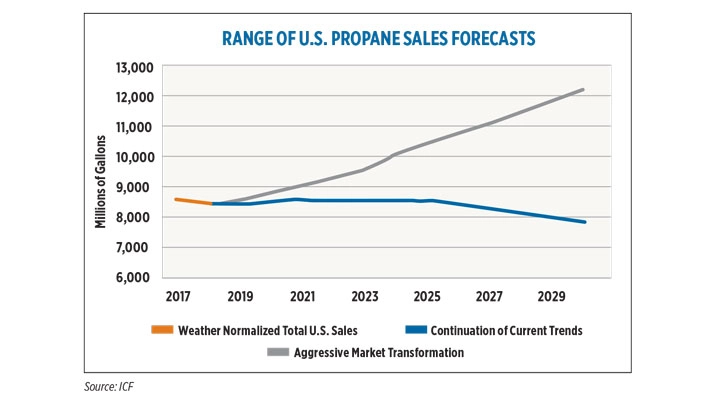
In the low case, which was based on a continuation of historical trends and market forces, we predicted that gallons sold in the 2020s would decline from 8.7 billion in 2020 to 7.9 billion gallons by 2030. We also presented a high case based on an aggressive market transformation path, led by growth in the autogas and power generation markets. We projected that if the industry was able to capture market share in these markets, gallon sales could increase to 12.1 billion gallons by 2030.
During the first five years of the forecast (2020-24), the industry was unable to move beyond the historical pattern. Headwinds from appliance efficiency improvements, decarbonization/electrification efforts and lack of market development in the power generation and autogas markets more than offset overall market growth.
The slow decline in gallons sold occurred despite improvements in propane affordability and significant growth in the number of residential space heating customers. Between 2000 and 2024 (the last year of available data), the number of propane-heated households increased by about 380,000, or about 6 percent. However, despite the increase in households, total residential propane sales declined by about 350 million gallons, or about 9 percent. While some of the decline was due to weather patterns, much of the decline was due to a decrease in the weather-adjusted use per customer.
The weather-adjusted decrease in propane sales per customer was largely due to improvements in energy efficiency as old propane furnaces and water heaters were retired and replaced with higher efficiency units and as new customers installed higher efficiency equipment. The increase in customers and the decline in consumption per customer have both been consistent long-term trends.

▶ Market trends drive updated forecast
The same trends that have driven propane sales over the past five years are expected to continue to drive propane sales over the next 10. However, the relative importance of these factors has changed, in some ways dramatically. Here are the five factors, in order of significance, that we think will shape the industry’s gallons sold during the next decade.
1. Heat pump technology advancements – Recent improvements in heat pump technology impacting the three critical measures of heat pump performance will significantly threaten the residential propane space heating market. They are 1) efficiency – hence lower energy costs; 2) comfort from the heat generated; and 3) lower outdoor temperature until a backup is needed. The same factors will have a similar, albeit smaller, impact on the residential water heating and the commercial space and water heating markets. As we discuss here, this market driver will be much more important over the next five to 10 years than it has been in the past five years.
2. Diesel (and gasoline) displacement opportunities – Tougher emissions standards and demand for eco-friendly, reliable energy provide opportunities for propane as energy decision-makers in power generation and transportation seek to switch from diesel to an alternative fuel. These opportunities remain critical to the industry, but the industry is arguably less prepared to take advantage of these opportunities than it was in 2019.
3. Concerns of power shortages and rising electricity costs – Propane has the potential to become an attractive solution for consumers, policymakers and utilities as they grapple with concerns about power shortages and peak shaving.
4. Decarbonization/electrification policy – The Inflation Reduction Act’s homeowner incentives to switch from gas to electricity and progressive state energy legislation, e.g., New York and Virginia, are evidence that aggressive climate change policy and incentives can hurt propane. These policies will swing back and forth as administrations change. However, much of the impact of these policies is already baked into the market due to technology changes stimulated by earlier decarbonization policies and international efforts to reduce reliance on fossil fuels.
5. Shale gas revolution – Plentiful domestic production will keep propane supply costs flat or perhaps declining in the next decade. This bodes well for propane in a period of rising electricity costs and grid resilience concerns.
You May Also Like
-

Hilco acquires J-M Transport from Crystal Flash
Sep 30, 2026 -

Denver Propane Exchange sells to undisclosed buyer
Sep 29, 2026 -

Propane market outlook
Sep 28, 2026




Subscribe to LP Gas
If you enjoyed this article, subscribe to LP Gas to receive more articles just like it.