


US refineries not meeting demand
Trader’s Corner, a weekly partnership with Cost Management Solutions, analyzes propane supply and pricing trends. This week, Mark Rachal, director of research and publications, explains why refineries can’t keep up with fuel demand.
Catch up on last week’s Trader’s Corner here: Propane inventories break record high
U.S. refiners are running their units hard to try and keep up with demand for refined fuels, especially distillates that include diesel and heating oil. Unfortunately, they are losing ground, as is the rest of the world. The wars in Europe and the Middle East have exposed a concerning trend of declining refinery capacity outside of Russia and China.
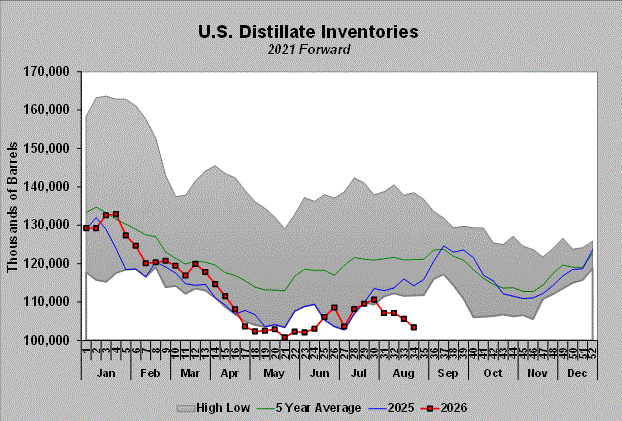
We discussed the concerns with distillate inventory in Trader’s Corner just a few weeks ago; things have only gotten worse since then. Inventories have gone from just above the five-year low mark to well below it over the last four weeks. Obviously, this is a very concerning trend, and distillate prices reflect it. ULSD at New York Harbor is $4.31 per gallon, the equivalent of $2.84 per gallon of propane.
The drop in inventories comes as refineries are working at near capacity.
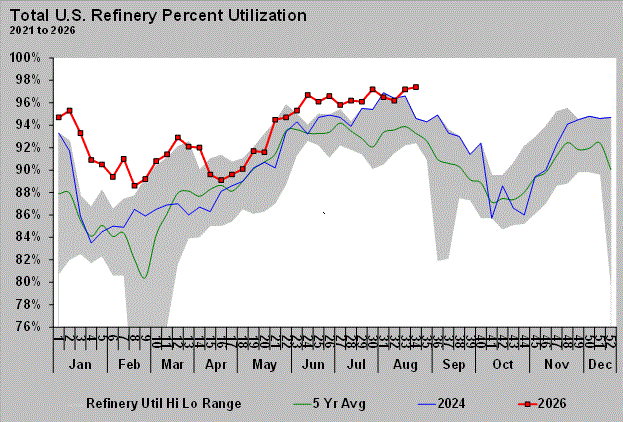
Last year around this time, we wrote about our concern with high utilization rates relative to the potential impact on propane supply. Utilization rates were at five-year highs and stayed high at a time when refineries would normally be taking units down for maintenance. Our concern was that delayed maintenance work would go deeper into the fall and winter than normal. That could have meant propane supplies from local refineries would not have been available when propane retailers needed it.
This year, there are concerns with utilization rates at five-year highs again. We know that this didn’t become a major issue for propane supply last year, so we are not as worried about propane supply specifically as we were last year. But we are worried about refined fuels supplies overall.
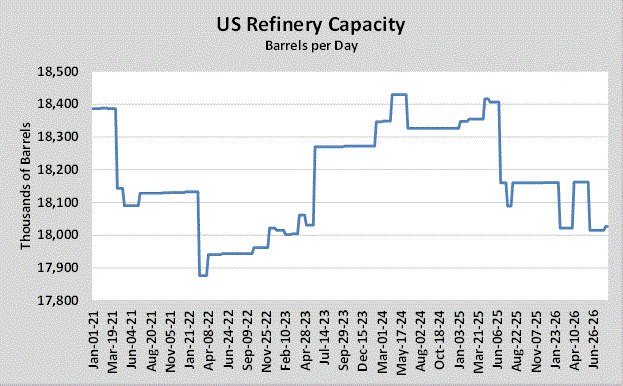
U.S. refining capacity is not growing. In fact, it is lower now than it was five years ago. Refineries are not popular, and globally, the capacity has fallen to just enough to get by. Much of the capacity for Europe was in Russia, and Ukraine has made it a strategic objective in its war with Russia to use drones to attack refineries, significantly impacting supply for Europe. Disruptions to Middle East supply have been more impactful on supplies from China. China has been supplying an increased amount of refined fuels to Asia and has reduced exports at times this year because of the impact the U.S.-Iran war is having on supplies.
That is putting more pressure on an already taxed U.S. refinery system to try to make up supplies for our friends.
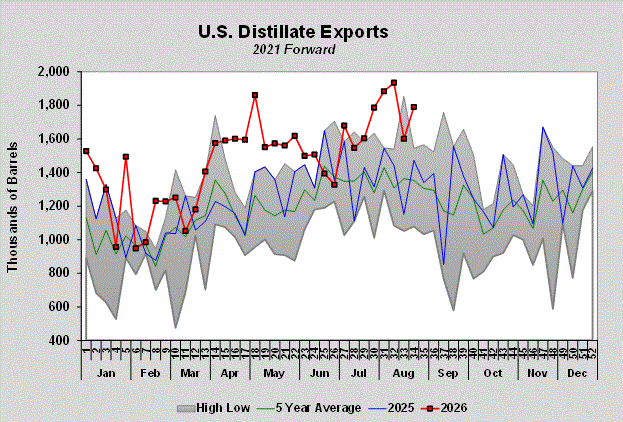
As Chart 4 shows, the United States is exporting distillate at rates that are setting new five-year highs despite domestic supply at five-year lows and trending in a concerning way. U.S. domestic demand is being impacted by the higher prices. Domestic demand is trending below last year but not as much as you would think with prices so high.
Of course, with the high utilization rate, U.S. refineries are churning through large amounts of crude.
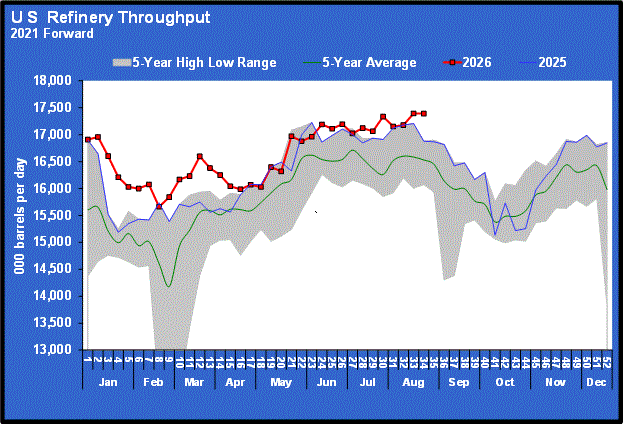
The highest refinery utilization rate was recorded in the summer of 2018 before COVID-19 hit. It’s been a slow process, but throughput rates are nearing that rate again. Last week, the throughput rate was just 588,000 barrels per day below the record.
Who knows when the war between Ukraine and Russia will end. They seem content to fight forever despite the human and economic costs. The war between the United States and Iran may have entered a new phase that could help bring it to an end, but it is hard to say how long the Iranian regime will hang on as the United States attempts to crush it economically. If these wars continue, limited refining capacity in industrialized nations is going to be a problem and so is distillate supplies.
The high cost of diesel is literally fueling inflation, causing problems for the global economy. The U.S. Federal Reserve is considering an interest rate increase because of persistently high inflation. We think it would be a mistake to raise rates given inflation is being driven by the war, not because the underlying U.S. economy is particularly healthy.
The issues with distillates will not necessarily go away if the U.S.-Iran war ends. Supply could be tight for a long time, given the reduced refining capacity in industrialized nations. And maybe not even the end of the Russia-Ukraine war, which would probably be even more helpful with the distillates shortage, will solve the problem.
The world can’t seem to break its addiction to hydrocarbons, yet many industrialized nations, especially those in Europe, and to a lesser extent the United States, are eliminating their ability to provide the refined products that are still very much in demand. The attitude seems to be: unbuild it (refining capacity) and the alternative energy sources will come. Well, it turns out we have been more proficient at unbuilding than developing alternatives. A classic case of putting the cart before the horse.
The administration is meeting with refiners this week to look for ways to bring down U.S. energy costs. We can’t help but wonder if someone in the administration will recommend cutting off distillate exports as Russia and China have done.
Charts courtesy of Cost Management Solutions.
To subscribe to LP Gas’ weekly Trader’s Corner e-newsletter, click here.
You May Also Like
-
Propane prices, valuation shifting
Oct 12, 2026






Subscribe to LP Gas
If you enjoyed this article, subscribe to LP Gas to receive more articles just like it.