


Propane prices, valuation shifting
Trader’s Corner, a weekly partnership with Cost Management Solutions, analyzes propane supply and pricing trends. This week, Mark Rachal, director of research and publications, explains what’s happening with propane prices.
Catch up on last week’s Trader’s Corner here: The ‘end of the beginning’ of the US-Iran war
U.S. propane prices are in a bullish uptrend. As we write this Trader’s Corner on the morning of Friday, Oct. 9, propane traded at over $1.00 per gallon, and other pricing points aren’t too far behind.
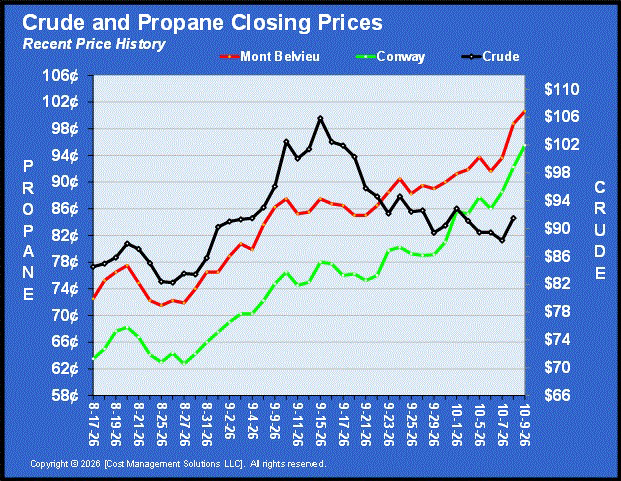
MB ETR is up 29.125 cents since Aug. 25. That is a 41-percent gain. Conway is up even more over that span, with a 32.5-cent (52 percent) increase. At this point last year, MB ETR propane was at 67.375 cents and Conway was at 58.75 cents.
So we are beyond the point where consumers are going to feel the difference when they get their heating bills this winter. Given the price of gasoline and diesel, most are likely expecting to be shocked by their heating bills.
The year-over-year increase in propane is mostly because crude is so much higher. WTI crude is at $91.49 at yesterday’s close, up $31 dollars per barrel or 48 percent over the year.
But during the middle of September, propane started separating from crude, which now has propane up more than crude this year. MB ETR is up 33.25 cents year-over-year, or 49 percent, while Conway is up 36.75 cents, or 63 percent.
That puts propane about 18 to 20 cents higher than the 10-year average price for this time of year. That adds a lot of downside price risk to any long position on propane taken at this point, so such positions should only be taken with the utmost caution.
The separation from crude is interesting, given that propane inventories are in better shape than crude’s inventory. However, crude has recently been retreating from its highs on reports of more crude going through the Strait of Hormuz. In fact, recent reports have shown exports out of the Middle East are now at prewar levels.
Meanwhile, propane inventories stopped building early this year.
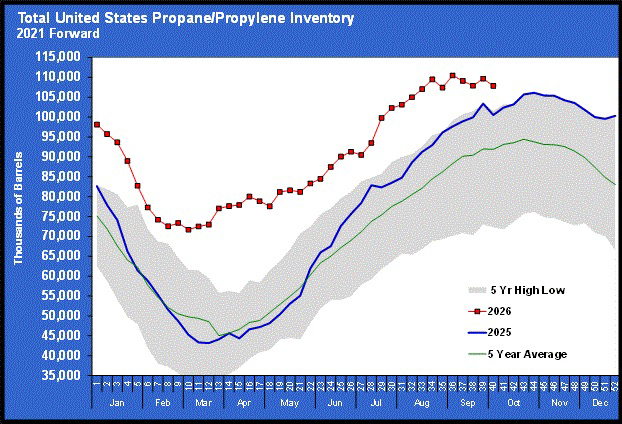
Inventory changes have been rather erratic over the last couple of months, but the net trend is flat. Normally, inventories would still be built during this period. This early flattening of inventories caused the revaluation of propane starting in mid-September.
To be sure it is not because we are short propane supply in any shape, form or fashion. Inventories are still at record highs for this time of year. The adjustment is based on the fact that propane was so undervalued beforehand. Even with this rally, propane is still valued a little less than the five-year average value relative to WTI crude.
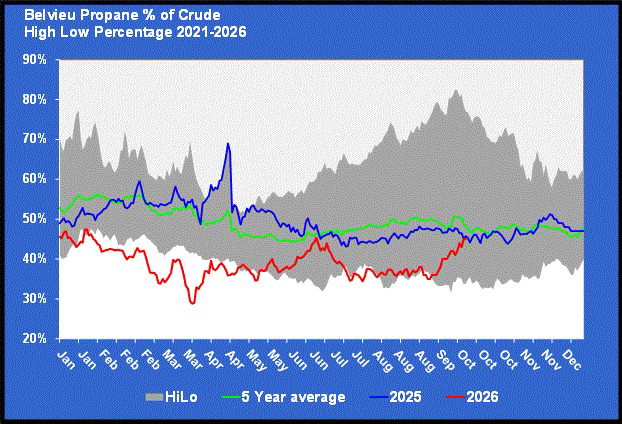
Chart 3 shows that MB propane set new five-year lows in relative value before this revaluation, and it is just now at last year’s levels and, as we said, still below the five-year average percentage of WTI crude’s value. The same comments could have been made for a chart of Conway’s relative valuation.
Propane is supported by two key elements: Propane export capacity is increasing, and with Middle East supply disrupted, it looks like that new capacity will be utilized this winter.
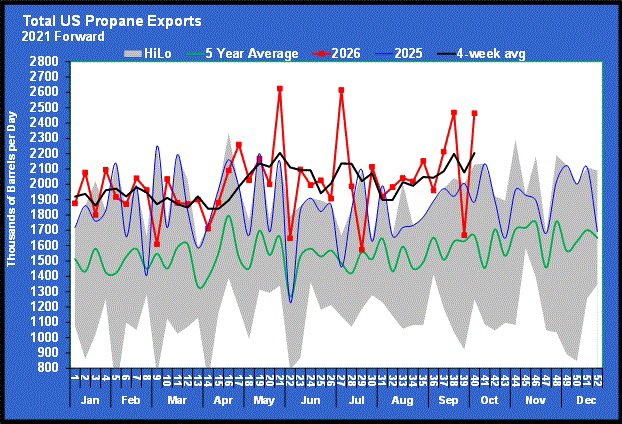
Propane exports are already setting five-year highs, and that is likely to continue. The odds are that when the new export capacity is available, export volumes will take another step higher since it doesn’t look like supplies from the Middle East will return to normal anytime soon. Even if the war ended today, it would take a while for the supply situation out of the Middle East to return to normal. That adds even more pressure to revalue propane to closer to its normal relative valuation to crude.
In summary, despite the recent gain in price, propane is not developing a premium as much as it is simply eliminating its persistent undervaluation. Expected high export demand and the early flattening of propane inventories leave little reason to keep propane prices as beaten up as they were.
Propane buyers should expect propane to be valued at its typical valuation relative to crude or perhaps even higher for the remainder of the winter and until the war in the Middle East ends and export demand decreases.
Charts courtesy of Cost Management Solutions.
To subscribe to LP Gas’ weekly Trader’s Corner e-newsletter, click here.
You May Also Like
-
The ‘end of the beginning’ of the US-Iran war
Oct 5, 2026




Subscribe to LP Gas
If you enjoyed this article, subscribe to LP Gas to receive more articles just like it.