

What insurance inspectors really look for at propane operations
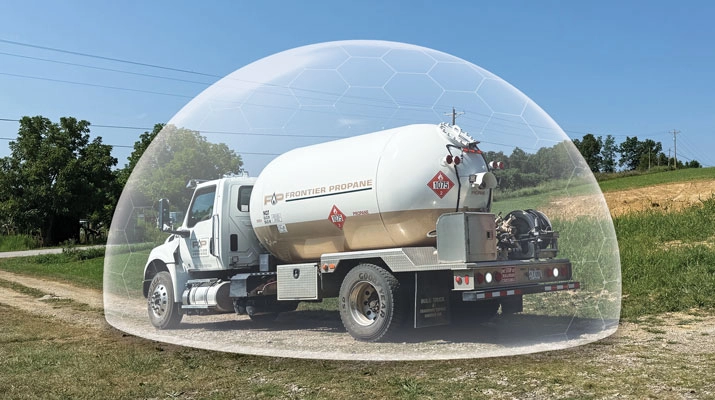
In a typical visit, when an insurance rep walks into a propane operation, the inspection extends far beyond bulk tanks and bobtails.

The agent may examine emergency shutoffs, crash protection and cylinder storage, but also parts of the company like driver files, customer agreements, training records and the documentation behind leak checks and out-of-gas calls.
The goal is not to find a flawless operation but to determine whether management understands its exposures and has built a culture capable of controlling them.

“The biggest difference between a well-managed operation and a higher-risk one usually isn’t whether I can find something wrong,” says Ashley Carmon, lead insurance agent at JMcLean Energy Insurance. “The difference is the culture surrounding it. A good operator knows where the risks are, documents what they’re doing, trains consistently and corrects issues when they’re identified.”
That distinction has become increasingly important as propane companies contend with higher-claim severity and greater underwriting scrutiny. Tom Mullaney, vice president of risk engineering for Aegis General Energy Division, notes reinsurance and umbrella costs are climbing, even as some new competitors enter the propane market.

“Anyone getting quotes this year is probably going to see 15, 20, 25 percent higher quotes than they got a year prior,” Mullaney says. “We’re seeing underwriters and reinsurers saying, ‘These books are undervalued. The losses are high, and we need more premium in order to get it under control.’”
Still, W. Dan Cramer, commercial account executive at First West Insurance, sees improving carrier appetite for propane marketers that can demonstrate sound procedures, reliable testing and a willingness to address past losses.
“There is a growing appetite for that best in class among those specialized insurance carriers with a propane program,” Cramer says. “If you’ve got a marketer that may have had some claims or a large claim, I still think there’s appetite if you’re able to show what you learned from that experience and what you’re doing differently.”
▶ The inspection begins with questions
PT Risk Management tries to visit every location before assembling a policy, according to producer Lauren Abbl. The initial review helps the agency understand building construction, bulk storage, vehicle fleets, gallons sold and other exposures.

Risk-management visits go further into handbooks, procedures and preparation for the carrier’s eventual loss-control inspection.
Mullaney also starts indoors. His review begins with a discussion of the operation, its strengths and pain points, followed by an effort to verify what management reports. If a company says it maintains strong customer documentation, Aegis may request a random sample of files covering new installations, existing accounts and service calls. The review can also encompass driver qualification files, hiring and training practices, maintenance records, customer contracts and fire safety analyses.
“You can’t tell us you’re doing something and then have us realize you’re not doing it,” Mullaney says. “You also can’t be doing it but not documenting it, because if you didn’t document it, it didn’t happen.”

The outdoor portion tests whether the written program matches reality. James Frommert, vice president at The Baldwin Group, says early questions include whether a facility is fenced and lighted, whether aboveground tanks have concrete crash barriers and how much training and tenure employees bring to the job.
“Safety is No. 1,” Frommert says. “What are the safeguards around the property immediately?”
Many deficiencies are inexpensive to correct. Abbl has seen overgrown vegetation around tanks in wildfire-prone areas, trucks parked without wheel chocks and hazmat placards so faded that drivers repeatedly received citations. Cramer commonly sees improper cylinder storage and gaps in driver training.
These are all worrisome because minor deficiencies become more concerning when they reveal inattention.
“You get several of those, and it adds up,” Abbl says. “It’s showing the underwriters that they’re not taking care of even the simplest thing.”
▶ Paperwork as the best witness
Documentation is vital. Insurers want consistent records for leak and pressure tests, out-of-gas calls, customer refusals, appliance changes, employee training, vehicle maintenance and underground-tank testing.
Abbl once encountered a leak-check form completed on the back of a lunch receipt. Although the technician may have performed the right work, an improvised record would provide little help in a serious claim. Digital systems can capture dates, times, test results, appliance serial numbers, photographs and technician information in one accessible record.
Carmon says propane marketers often perform more tasks correctly than their files suggest. The problem emerges years later when company records are missing, incomplete or inconsistent among employees.
“If there is a fire or explosion, and litigation begins several years later, the question isn’t simply whether your employee followed the proper procedure,” Carmon says. “The question becomes whether we can prove it. Five years later, the technician may not remember that customer. That document may be the only witness you have.”
Complete records also help insurance agents advocate for an account. Cramer notes some carriers want to see 100 percent completion of pressure and leak tests, while others may consider a marketer that has documented measurable progress toward that goal. Mobile systems can show not only that a test was completed but also which appliances were present during the visit. That information can help determine whether an appliance involved in a later incident was installed after the propane company’s work.
The stakes reflect an imbalance between the frequency and severity of losses. Mullaney estimates that auto liability and physical damage generate about 80 percent of incidents at propane companies. Yet failures involving gas checks, leak tests and out-of-gas procedures represent a smaller share of claims but about 80 percent of claim dollars.
“That 20 percent of incidents is really driving the experience in the industry,” Mullaney says. “If you’re not doing 100 percent documented gas checks and 100 percent documented leak tests on out-of-gas systems, you’re probably not getting a policy.”
You May Also Like
-
ThompsonGas acquires Dixie LP Gas and Gas Heat
Oct 22, 2026





Subscribe to LP Gas
If you enjoyed this article, subscribe to LP Gas to receive more articles just like it.