


Propane market outlook
Catch up on last week’s Trader’s Corner here: European natural gas inventories fall below normal

The second day of the LP Gas Growth Summit kicked off with a presentation from Cost Management Solutions Vice President Dustin Delay.
Delay’s presentation covered an outlook of the propane market for the rest of 2026, featuring topics like supply, fuel costs, risk management and hedging.
How we got here
Delay discussed the timeline of events that led to the current propane market situation.
Propane inventories and production have been climbing to record-high levels. Additionally, domestic demand has dropped to a nearly five-year low. These factors have helped keep prices down in 2026, especially when compared to other fuels.
However, when the United States invaded Iran, the resulting war shut down the Strait of Hormuz, disrupting supplies in the Middle East.
“When there’s unrest in the Middle East, propane’s always going to be crazy,” Delay explains.
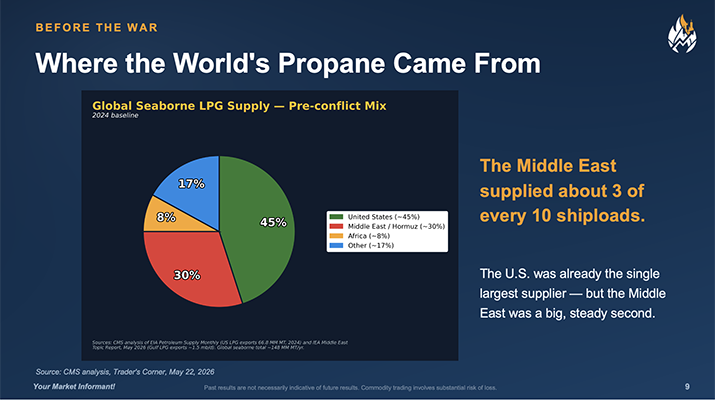
Since roughly 30 percent of all global propane shipped by sea passes through the Strait of Hormuz, this disruption had global impacts on supply.
Since then, foreign demand for U.S. propane has increased significantly, as the rest of the world looked to the United States to fill the supply gap. This increase in demand has caused some increase in propane prices, but propane is still priced fairly cheaply relative to other fuels.
Waiting for winter fill-ups
Nonetheless, any price increase, no matter how minor, is bound to weigh heavily on customers’ minds. Delay expressed concern about customers putting off their regular tank fill-ups in hopes of prices coming down before winter.
“They’re waiting for the Iran war to go down so that they can fill up their tank,” Delay surmises.
If customers continue to wait for prices to fall, they may not fill up until the cold winter weather hits and finally forces them to order more propane. According to Delay, such a sudden influx of orders could create propane supply and delivery problems.
As an additional wrinkle, prices may not even fall by winter. With no clear end to the U.S.-Iran war in sight, foreign demand could continue to keep prices elevated.
Additionally, a strong El Niño winter is predicted. While such a strong El Niño can lead to a warmer winter in certain parts of the country, which would leave plenty of propane available in storage, it could also lead to an incredibly cold winter, which could strain supplies.
Risk management
Delay explained how the retailers in attendance could start hedging to manage their winter supply risk.
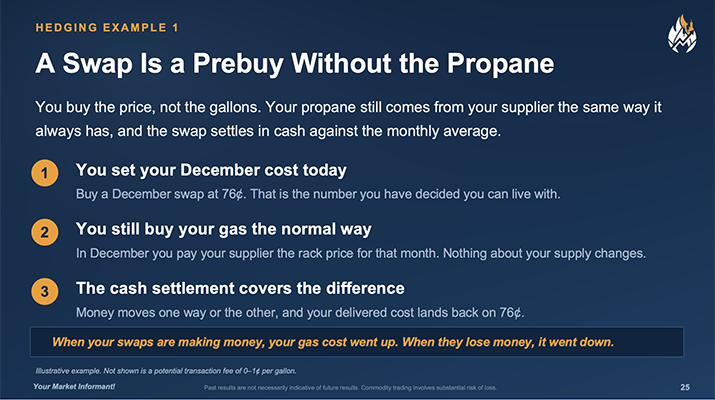
One hedging tool available to retailers is a swap. A swap lets a retailer lock in a propane price for future months, up to three years out.
“A swap is really just a pre-buy, but you have no gallons attached to it,” Delay explains. “It’s just a financial transaction. You’re buying the price; you’re not buying the gallons.”
Here’s a hypothetical example. In October, a retailer agrees to a swap at 76 cents per gallon for December. If December propane averages 90 cents, the swap pays him 14 cents. He still pays 90 cents for his physical propane, but the swap gain brings his net cost back down to about 76 cents.
It works the other way, too. If December averages 60 cents, the retailer owes 16 cents on the swap. Their physical propane only costs 60 cents, though, so their net cost still comes out to about 76 cents. The tradeoff is that the retailer gives up the benefit of lower prices. That’s the cost of knowing their number ahead of time.
Retailers can also use storage swaps. With this approach, a retailer buys the propane they’ll need for winter early and puts it in storage. The same day, the retailer sells a swap for the same number of gallons in the month they plan to use them. When that month comes, the swap settles against the average market price.
For example, say a retailer buys propane in September at 75 cents and stores it in a tank. That same day, the retailer sells a December swap for the same gallons at 90 cents. They are now locked in a 15-cent spread on those gallons, before storage, financing and transaction costs.
Delay emphasizes that swaps involve risk of loss, credit requirements and transaction costs. Hedging isn’t suitable for every retailer.
“The idea behind all this is you know exactly what you’re going to have before you even get there,” Delay says. “It helps you sleep better at night and not think about it as much.”
To subscribe to LP Gas’ weekly Trader’s Corner e-newsletter, click here.
You May Also Like




About the Author: Chris Markham
Chris Markham is the managing editor of LP Gas Magazine. Contact him at cmarkham@northcoastmedia.net or 216-363-7920.


Subscribe to LP Gas
If you enjoyed this article, subscribe to LP Gas to receive more articles just like it.