


European natural gas inventories fall below normal
Trader’s Corner, a weekly partnership with Cost Management Solutions, analyzes propane supply and pricing trends. This week, Mark Rachal, director of research and publications, examines the state of natural gas in Europe.
Catch up on last week’s Trader’s Corner here: Strong run in propane prices
As winter nears, European natural gas inventories are at 68 percent of storage capacity compared to the normal inventory position of 85 percent. European supplies have been disrupted by the war in the Middle East. Europe had been weaning itself off natural gas supplied by Russia, essentially in protest of Russia’s invasion of Ukraine, making the continent more dependent on Middle East and U.S. supply.
The low inventory position has been pushing natural gas prices higher. Some say the higher natural gas prices have been more impactful than the rise in crude prices in Europe. In Germany, a fringe political party advocating buying natural gas from Russia again has been winning elections.
In Europe, natural gas is sold in euros/MWh. On Friday morning, European natural gas was trading at 78 euros per MWh. In the United States, natural gas is sold in MMBtus. The U.S. price Friday morning was $2.8520 per MMBtu, or the equivalent of 26 cents per gallon of propane. The first step in comparing the natural gas price in the United States and Europe is to convert euros per MWh to euros per MMBtu, which is 23.04 euros per MMBtu. Then we must make the currency conversion. Each euro is worth $1.15. So, each MMBtu of natural gas in Europe is the equivalent of $26.50 in the United States.
That means that natural gas in Europe is 7.68 times the price of natural gas in the United States. Obviously, U.S. producers are incentivized to sell as much natural gas as possible in Europe. However, there are shipping and export capacity restraints that limit the amount of exports.
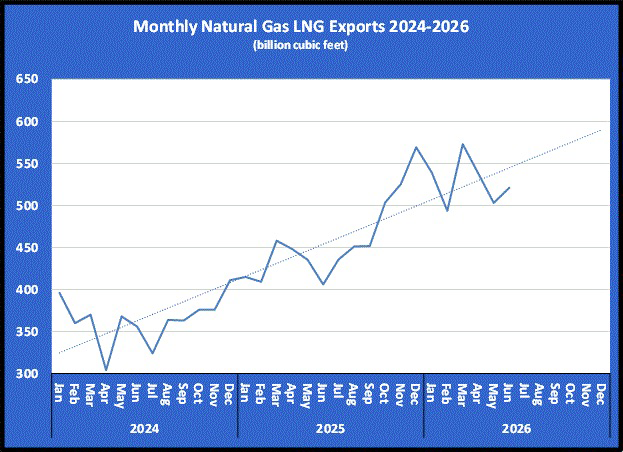
The United States has been increasing its liquefied natural gas (LNG) exports since Russia invaded Ukraine. But the growth has been slow due to how long it takes to add more LNG export capacity. A new facility takes about five years to construct. The environmental studies time and permitting procedures have been shortened under the Trump administration, but it still takes a long time to increase capacity.
U.S. companies were prohibited from exporting natural gas until 2016. In 10 years, the export rate has grown to 521 billion cu. ft. per month in June (latest date available). The high rate was 538 billion cu. ft. in March.
Further, there is a fear in the United States that once the Ukraine/Russia war ends, Europe will return to buying Russian natural gas, even though its current leadership says it will not. But the recent election results in Germany show how much political pressure will be on European governments to return to cheap Russian supply. So caution by U.S. companies and investors in adding more LNG export capacity appears warranted.
U.S. natural gas production has been increasing primarily to meet increased export demand.
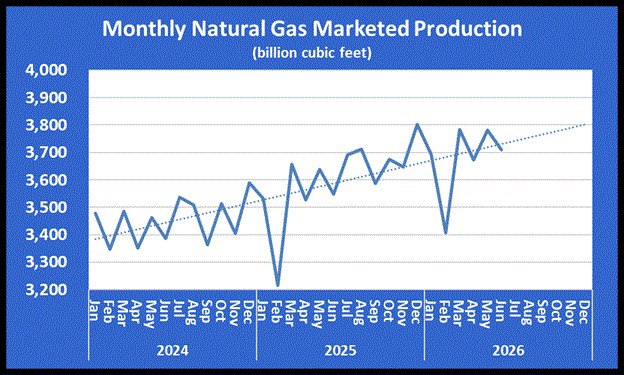
U.S. marketed production in June was 3,709 billion cu. ft. That means the United States is exporting only 14 percent of natural gas production. By comparison, the United States produced 2.973 million barrels per day (bpd) of propane last week and exported 2.213 million bpd, or 74 percent.
Even though domestic demand for propane is not increasing, its supply continues to grow. As long as the world is demanding more U.S. crude and natural gas, that will remain the case. But again, export capacity remains the constraint.
Last week, U.S. producers had 132 drilling rigs actively drilling new gas wells. That is up 14 from the same week last year. By comparison, there were 1,500 rigs actively drilling for natural gas in the early phase of the shale gas boom in 2008.
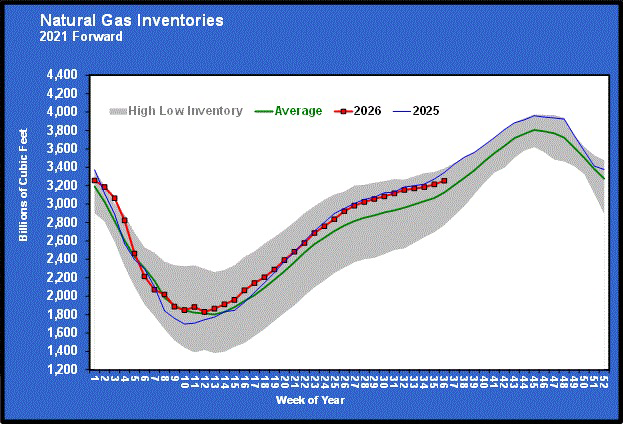
Recently, U.S. natural gas inventories have been falling below last year’s levels, so there is room for more production. Europe is going to need every MMBtu of LNG the United States can export this winter. That has the potential to cause natural gas prices to go higher. The good news for propane retailers is that higher natural gas prices do not impact propane prices. Propane is priced relative to crude.
A rise in natural gas prices would not put upward pressure on propane prices. In fact, higher prices would encourage more natural gas drilling and production, which would add to the surplus of U.S. propane supply.
So, we are preparing propane retailers for the possibility of rising natural gas prices this winter. If that happens, it will start hitting the headlines. But remember, if it occurs, it should not increase propane prices. In fact, the natural response to higher natural gas prices would be to produce more where possible, which only works to increase propane supplies.
Charts courtesy of Cost Management Solutions.
To subscribe to LP Gas’ weekly Trader’s Corner e-newsletter, click here.
You May Also Like
-
Strong run in propane prices
Sep 14, 2026 -

How LP Gas continues to raise the bar on coverage
Sep 10, 2026


About the Author: Chris Markham
Chris Markham is the managing editor of LP Gas Magazine. Contact him at cmarkham@northcoastmedia.net or 216-363-7920.


Subscribe to LP Gas
If you enjoyed this article, subscribe to LP Gas to receive more articles just like it.