


Iran peace deal’s impact on propane markets
Trader’s Corner, a weekly partnership with Cost Management Solutions, analyzes propane supply and pricing trends. This week, Mark Rachal, director of research and publications, shares how a potential peace deal in the U.S.-Iran war could affect propane markets, prices and inventories.
Catch up on last week’s Trader’s Corner here: How the US-Iran war draws on propane inventory
(Editor’s note: As of the morning of June 15, the United States and Iran have reached a deal to extend the ceasefire, end the war and open the Strait of Hormuz. This is an ongoing situation and a developing story.)
We went into another weekend with expectations and promises that a peace agreement between Iran and the United States is close. According to the latest reports as of this writing, a memorandum of understanding for what would be included in a long-term peace deal could be agreed to by June 13, with a signing ceremony to be held later in Geneva. U.S. Vice President JD Vance would be present to sign the memorandum on behalf of the United States.
Reports from the Iranian side are that they have not wavered on their core demands. If what they say about the document is accurate, President Donald Trump’s political influence will likely be over. According to the Iranians, they will only agree to further discuss the fate of their nuclear program in the future. If the memorandum of understanding does not state that they agree to end their nuclear program and dilute or disperse their enriched uranium, the war will be framed as meaningless.
Furthermore, Iran says the United States will have to remove all military assets from the region, unfreeze Iranian assets and pay Iran $300 billion as war reparations. It also says that the fighting between Israel and Hezbollah in Lebanon must stop. Israel has already stated it is not a party to the memorandum that is being considered.
And of course, the current regime would remain in place along with its radical worldview that will always see the United States, Israel and the West as the enemy, which will also be correctly framed as nothing fundamental being changed by the war.
It is possible that as you read this Trader’s Corner, a deal has been signed. The key element for those of us in the energy industry will be if the agreement states that the Strait of Hormuz will be fully opened as a free and open waterway and not under Iranian control. If Iran has any control over the strait, much less is allowed to charge transit fees, the war will be framed as not only meaningless but having resulted in Iran being in an even stronger position.
Nonetheless, the opening of the Strait of Hormuz and the resumption of normal ship traffic under just about any conditions should see energy prices fall and hopefully take the pressure off propane and crude prices going into this winter.
Just the rhetoric and promise of peace have caused prices to trend lower recently.
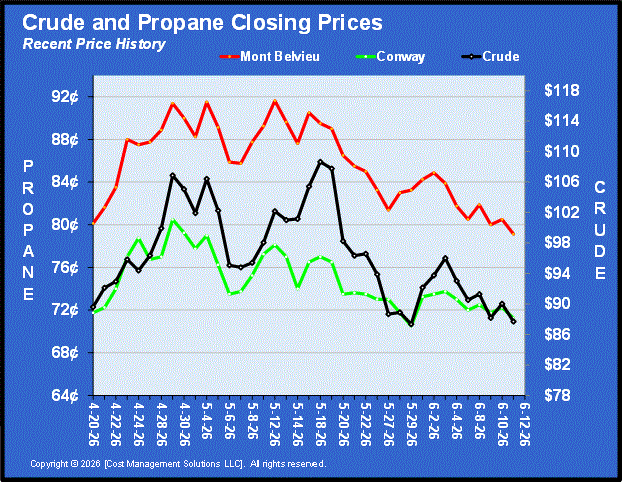
As we write, WTI crude is $84.60, about $25 higher than it was running before the war. We do not anticipate crude prices returning anywhere near the $60 level, even if the war ends with the Strait of Hormuz operations returning to their pre-war status.
Globally, crude commercial inventories and strategic reserves have been brought down considerably. Until those inventories and reserves are restored, both refiners and governments will be competing for the barrels. We would anticipate the medium-term floor for crude to be $75 per barrel. That would mean crude trading about 25 percent above pre-war levels over the mid-term (the term being a year or two).
Mont Belvieu propane was running about 63 cents per gallon in mid-February before the war premium started being added. At its current 79-cent price level, Mont Belvieu propane is up 25 percent because of the war. Which means propane prices could already be where we think crude prices are going at a 25 percent premium to prewar prices. That could mean propane prices will significantly resist the fall in crude’s price to the $75 level.
If crude falls to $75 per barrel from where it is the morning of writing, it will be an 11 percent decline. We do not think that propane buyers should expect propane prices to fall 11 percent as well. We would not be surprised by just a 5 percent drop in propane to around 74 cents as likely unless propane inventories show a dramatic recovery.
Even at that level, propane would be valued at just 41 percent of WTI crude, which would be below normal. Propane would normally be valued at 44 percent of WTI crude this time of year and trending higher as winter approaches.
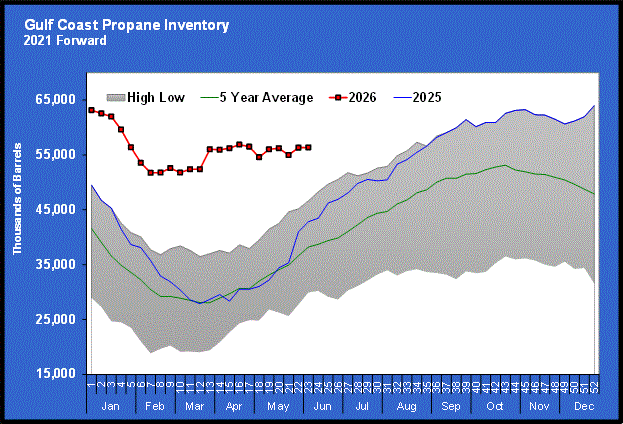
As Chart 2 above shows, inventories of propane on the U.S. Gulf Coast, which impact Mont Belvieu pricing, have essentially flatlined. Even if the Strait of Hormuz has reopened as you read this, we think the demand for U.S. propane could remain high for a couple more months, mid-August at the least.
That could very well mean that the massive overhang of Gulf Coast inventory that has been present for 10 months could be gone, with inventories near last year’s levels going into winter. At the start of last winter, MB propane was valued at 69 cents, and that was crude at $62 per barrel. That means propane was valued at 47 percent of WTI crude.
If crude is at $75 at the start of this winter, propane is likely to be valued somewhere between 41 percent and 47 percent of the value of WTI. That would put MB propane in the 73 cents to 84 cents range. The current price is already in the middle of that range. So, we do not expect a major improvement in the pricing situation for propane between now and winter.
Hopefully, we will be wrong, and propane inventories will recover much quicker than we anticipated, allowing propane prices to return closer to their pre-war relative valuation to WTI, which would put them on the lower end of the relative valuation above at around 41 percent.
We can also hope that the relief of the war being over will push crude below the $75 level we are predicting. If both propane inventories recover quickly and crude falls more than we anticipate, a better pricing environment might develop. To see propane valued at sub-40 percent of WTI is probably going to mean a lot of things have gone right for propane buyers.
Conway is already priced at just 71.5 cents, so we would expect even less downside potential there.
Charts courtesy of Cost Management Solutions.
To subscribe to LP Gas’ weekly Trader’s Corner e-newsletter, click here.
You May Also Like
-
Strong run in propane prices
Sep 14, 2026 -

How LP Gas continues to raise the bar on coverage
Sep 10, 2026

About the Author: Chris Markham
Chris Markham is the managing editor of LP Gas Magazine. Contact him at cmarkham@northcoastmedia.net or 216-363-7920.


Subscribe to LP Gas
If you enjoyed this article, subscribe to LP Gas to receive more articles just like it.