


Unexpected rise in US propane inventories
Trader’s Corner, a weekly partnership with Cost Management Solutions, analyzes propane supply and pricing trends. This week, Mark Rachal, director of research and publications, describes what he calls a remarkable rise in U.S. propane inventories.
Catch up on last week’s Trader’s Corner here: Distillate prices becoming brutal
The Energy Information Administration (EIA) provided its latest Weekly Petroleum Status Report on July 29, showing that U.S. propane inventories increased 2.510 million barrels, leaving them at 102.286 million barrels.
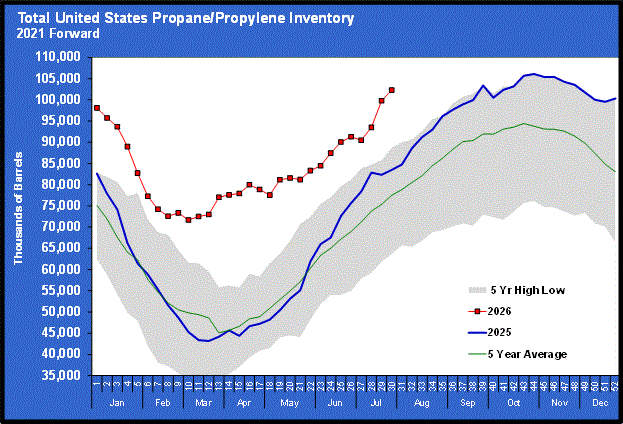
Since dipping at the start of July, inventories have gained a remarkable 11.825 million barrels. We say it is remarkable because we expected inventories to continue trending toward last year’s levels until the start of winter. We fully expected all the massive inventory excess over last year’s levels would be gone by the start of winter or soon after.
Even after the United States and Iran announced a 60-day ceasefire that opened the Strait of Hormuz, we expected export demand to remain higher through August, thus limiting inventory builds. Then, once the ceasefire broke and ships traversing the Strait of Hormuz came to a near stop again, we not only had confidence that inventory builds would be below normal through August, but that it would continue beyond then. We imagined foreign and domestic buyers competing for supply well into the U.S. winter, causing increased upward pressure on propane prices.
Boy, have we been wrong. The builds in inventory have been quite remarkable, headlined by a much higher than normal 6.5-million-barrel build two weeks ago.
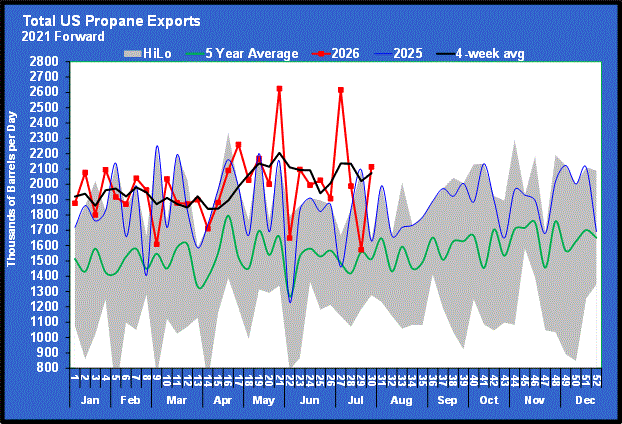
U.S. propane export volumes have remained elevated. We try to ignore the weekly volatility and focus on the four-week average (represented by the black line in Chart 2) to see through the clutter and get a better feel of how exports are trending. But it hasn’t been enough to cause the light inventory builds we expected.
The reason is that U.S. domestic demand has fallen off the table.
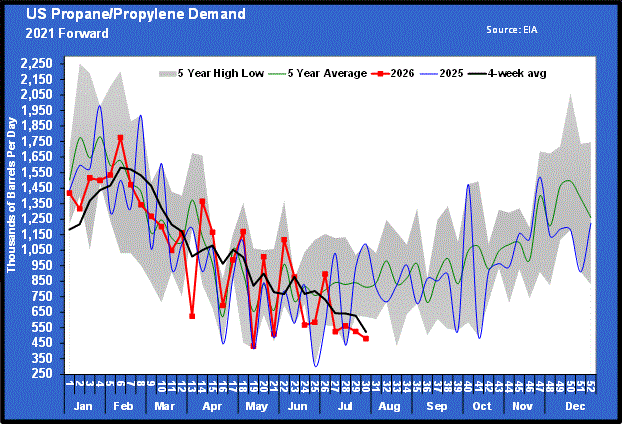
You may recall us predicting how inventory builds would go early in the summer. We estimated that U.S. domestic demand would drop from its elevated levels at the time to around 800,000 barrels per day (bpd) during the summer months. We got more than we bargained for on that front. From the start of April, domestic demand has averaged 783,000 bpd this summer. That isn’t too far below our estimate.
However, over the past seven weeks, domestic demand has averaged just 592,000 bpd and was down to 480,000 bpd for the week ending July 24 (the latest data). Domestic demand set new five-year lows several times over that span.
The concern with that development is that summer fills and other typical summer marketing activities that typically level out domestic propane demand are not going as usual. Could that mean consumers will head into this winter with propane in their tanks at a lower level than normal? If that is the case, it could be a hectic start to winter.
At this point, inventory levels at the trading hubs are high enough that we aren’t too concerned with them getting pulled down enough to impact pricing in early winter. However, it greatly increases the chances of logistical issues. Pipelines and transport trucks might struggle to keep up with an early surge in demand that could be higher than normal.
If customers haven’t been eager to fill their tanks this summer due to expectations that the war would end and better prices would become available, retailers are going to need to do what they can to have as much supply on hand as possible to limit the exposure to logistical issues.
Having bulk storage tanks full and, if available, railcars scheduled to arrive near that time might not be a bad idea. Keep in mind, you do not have to take price risk on either of those options if you fear prices will fall.
When a retailer fills storage or orders railcars, they assume the risk of falling prices. A way a retailer can mitigate that risk is to sell physicals at the same time they fill storage or order the railcar. Physicals are a paper position that can be closed on the day of choosing by the holder.
Let’s take a railcar, for example. If a retailer orders a railcar of 30,000 gallons today to be delivered during the first week of October due to concerns about tight supplies, thanks to the situation we discussed above, they immediately take on downside price risk. They will pay today’s prices for the railcar when they order, and if they’re unlucky, the U.S.-Iran war will immediately end, making propane prices fall precipitously.
To avoid downside price risk, the retailer would sell a physical position, and on the day the railcar arrives on their rail siding, they would close the physical position. If prices have fallen between the time the railcar was ordered and the time it arrives, the paper physical would offset the drop.
One important thing to understand about this is that if prices go up – in other words, the value of the propane in the railcar goes up from the time it was ordered – the retailer gets no windfall. If prices go up, the paper physical will lose money, and the gain from buying the propane in the railcar will be given up to offset the loss on the paper physical.
But remember, the retailer was not trying to make a windfall on the 30,000 gallons of propane in the railcar. The purpose was to mitigate the risk of higher propane prices due to logistical issues with wet supply at the start of winter. The combination of buying the railcar and selling the paper physical is to allow the retailer to commit to the physical supply in advance without taking undue price risk.
The situation with storage would work the same. A retailer that is hesitating to fill a 30,000-gallon bulk storage tank for fear the war will end and prices will fall assumes the risk of being short on wet supply at the start of winter. If the retailer assumes 30,000 gallons will be delivered from the storage in the month of October, he could fill the storage today and immediately buy an October physical or swap to cover downside price risk. A swap would work as well as the physical in this case, since the supply would likely be delivered to customers ratably over the month of October.
If prices fall between the storage being filled and October, the paper physical or swap offsets the loss. But if prices rise, the increased value in the stored propane will be used to offset the loss on the physical or swap.
Remember, the retailer is mitigating the risk of falling prices so they can confidently put the wet barrels in place that they will need to start winter. Normally, propane retailers are short of the supply they will need for customers, so the risk is that prices will rise. They buy swaps or physical to manage the risk of higher prices. But once they commit to supply, the risk becomes that prices will fall. In that case, they want to sell swaps or physicals to manage the downside price risk.
If you like the concept of managing supply and downside price risks in this way but are fuzzy on exactly how to make it happen, don’t hesitate to reach out to us. We will be happy to confuse you more if needed.
Charts courtesy of Cost Management Solutions.
To subscribe to LP Gas’ weekly Trader’s Corner e-newsletter, click here.
You May Also Like
-
Strong run in propane prices
Sep 14, 2026 -

How LP Gas continues to raise the bar on coverage
Sep 10, 2026


About the Author: Chris Markham
Chris Markham is the managing editor of LP Gas Magazine. Contact him at cmarkham@northcoastmedia.net or 216-363-7920.


Subscribe to LP Gas
If you enjoyed this article, subscribe to LP Gas to receive more articles just like it.