


Crude situation in Iran starting to improve
Trader’s Corner, a weekly partnership with Cost Management Solutions, analyzes propane supply and pricing trends. This week, Mark Rachal, director of research and publications, explains why the concerns about crude supplies are abating.
Catch up on last week’s Trader’s Corner here: Propane retains good value as demand declines
In our Trader’s Corner published on March 13, shortly after the United States began Operation Epic Fury with the goal of preventing Iran from securing a nuclear weapon, we said, “The war between the United States and Iran is really a war for the Strait of Hormuz.”
Whichever side controls that sliver of waterway that normally sees 15 million barrels per day (bpd) of crude pass through it would get its desired outcome from the conflict. The United States has said a deal was near to open the strait more times than we can count. At one point, it did open, but the ceasefire that allowed it lasted only a few days.
Iran’s key leverage in negotiations is to keep the strait closed, putting political and economic pressure on the United States to end the conflict. The pressure on President Donald Trump’s administration has often been evident throughout the conflict. Polls have shown the American people are not behind the war. It is hard for the average person to see the threat of a nuclear-armed Iran. However, it is very easy for them to see and feel the impacts of the high energy prices resulting from the war.
The unpopular war has shown up in recent elections, with the Republican Party losing seats at many levels of government. U.S. elections are almost exclusively about how U.S. citizens are feeling monetarily. Inflation is outpacing wage growth, and higher energy prices and high interest rates are straining budgets. It really doesn’t matter if the opposition party could do better; in many cases, they are actually presenting ideas that would make the situation worse. What matters is that the public responds to how it feels by punishing whichever party is making it feel uncomfortable. The U.S. electorate is consistent in this matter. Elections are not about principles, ideals or national security. They are about the cost of a dozen eggs and a gallon of gasoline.
Despite the political fallout, the Trump administration appears to be settling in for a longer game in getting the results it desires in Iran. To be clear, at the start, the United States wanted an end to Iran’s nuclear program. But as the war has developed, the focus has overwhelmingly changed to the Strait of Hormuz. At first, the United States believed it could achieve capitulation from the Islamic regime that controls Iran by bombing it into submission.
Indeed, the United States almost completely controls the situation militarily. Iran can put up little defense. However, the one thing it has continued to be able to do is attack unarmed commercial shipping trying to use the Strait of Hormuz. If it can do that, the regime will stay in the fight.
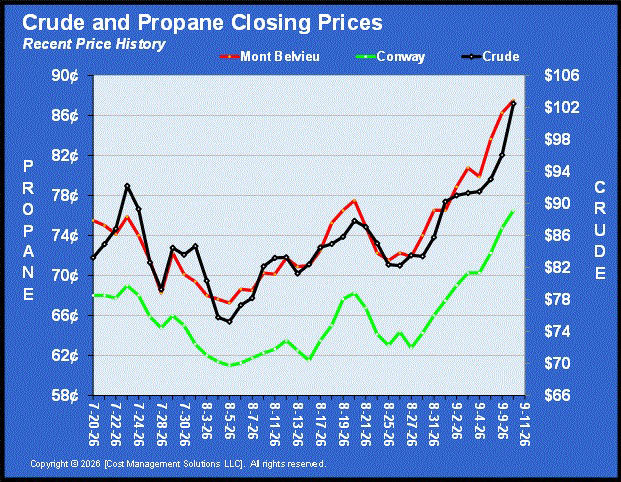
Iran’s ability to threaten shipping has caused global crude inventories to fall below 7.9 billion barrels for the first time since April 2025. In April, global crude inventories dropped 170 million barrels. The pressure on inventories put upward pressure on crude prices, with WTI crude reaching $106.88 in late April. Prices fell when the strait opened, and it looked like the end of the war was near. However, when negotiations failed, WTI crude reached $92.19 per barrel as recently as July 23. But last week, it fell to the mid-70s and is currently just over $80.
Ship tracking and news reports indicate the strait is not being used, with only a small number of ships passing through the strategic waterway. But U.S. Energy Secretary Chris Wright said last week that about 9 million bpd of crude is passing through the strait. If that is indeed the case, it could mean the U.S. military is gaining control of the strait, or at least enough so that some crude tankers are willing to risk using it.
Militarily, the United States must concentrate its entire effort on destroying anyone and anything that threatens ships in the Strait of Hormuz and provide enough protection to counter any drones or missiles the Iranian regime can deploy. For its part, Iran will concentrate all its efforts on sinking enough commercial ships in the strait to deter its use.
Until this week, it felt as if Iran was able to do enough to limit the use of the strait, but somehow, things feel different now. The U.S. administration seems more confident that it is in control. It appears to be shifting its focus to putting economic pressure on Iran and letting the regime collapse from within.
President Trump said that Iran has runaway inflation and is out of money. U.S. Treasury Secretary Scott Bessent said the United States is going to wage economic warfare toward Iran like no one has seen before. Secretary of Defense Pete Hegseth said the United States could keep the blockade on Iranian shipping for as long as it takes. It certainly sounds like the administration is focusing on an economic war.
With a more confident, calm vibe coming from the administration, the Energy Information Administration added to the vibe with its latest data.
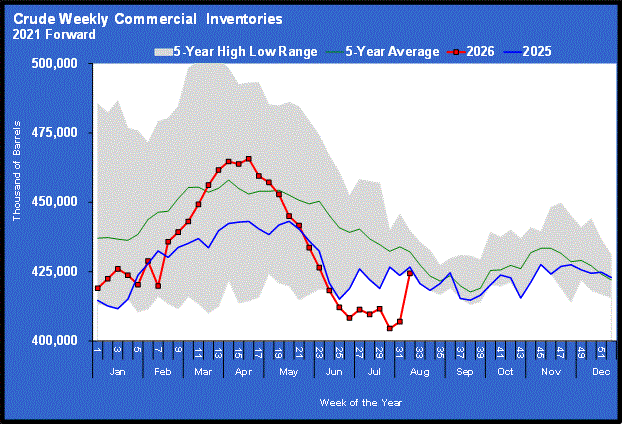
U.S. crude inventories surged 17.423 million barrels, increasing them to just 2.288 million barrels below this time last year.
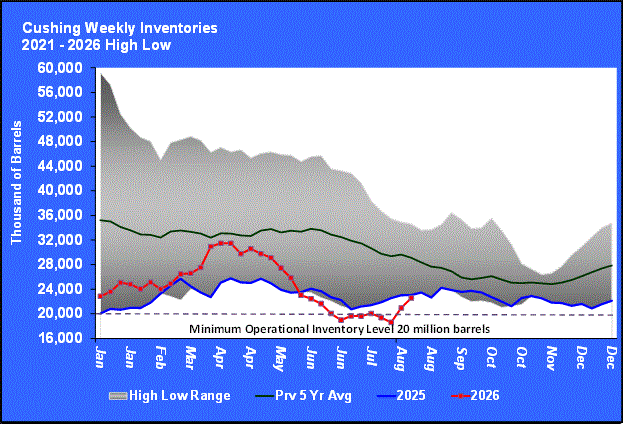
Just as importantly, over the last two weeks, inventories at the key U.S. trading hub of Cushing, Oklahoma, have come off the dregs, rising to a more comfortable operational level.
One area that remains a concern is that the level of U.S. strategic reserves of crude continues to fall.
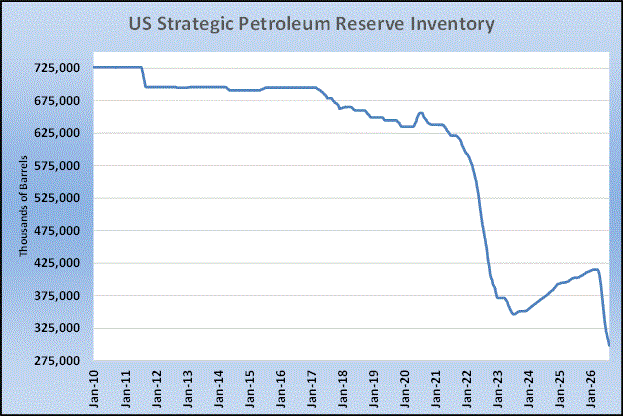
The use of strategic reserves to augment commercial supplies masks the underlying concerns. Hopefully the decline in strategic reserves will stop soon, allowing the market to get a truer picture of the supply/demand balance. It would be too much to ask for reserves to build at this point, but an end to their decline would certainly add to the better feeling about the supply situation.
There were also indications last week that high prices have hurt crude demand, which removes additional pressure from prices. OPEC lowered its crude demand growth expectations for this year to 580,000 bpd. The International Energy Agency, which looks at the world through the eyes of crude importer nations, made a dramatic revision to its crude demand outlook. It now thinks crude demand will contract by 1.6 million bpd this year after predicting growth of a million bpd just last month. In the 2010s, the annual growth was about 1.4 million bpd. Since then, the increase has been in the range of 650,000 to 750,000 bpd per year. A decline is as rare as peace in the Middle East.
If, and this is a big if, Secretary of Energy Wright is correct that 9 million bpd of crude is passing through the Strait of Hormuz, there could be light at the end of the tunnel on the U.S.-Iran war. The Islamic regime is fighting for its survival. There are reports it is killing more Iranian citizens to try and deter any thoughts of an uprising. The more economic pressure the United States can apply to the regime, the more inwardly focused it may become in order to survive. Hopefully that will lead to even more success in increasing crude supply through the Strait of Hormuz.
We have been discouraged about the United States’ inability to control the Strait of Hormuz. But this week, for the first time, we think that maybe, just maybe, we are seeing light at the end of the tunnel.
U.S. propane supply is in great shape going into winter. If the upward pressure on crude prices can be removed, we would feel good about it being a consumer-favorable winter.
Charts courtesy of Cost Management Solutions.
To subscribe to LP Gas’ weekly Trader’s Corner e-newsletter, click here.
You May Also Like
-

Propane market outlook
Sep 28, 2026 -
European natural gas inventories fall below normal
Sep 21, 2026 -
Strong run in propane prices
Sep 14, 2026




Subscribe to LP Gas
If you enjoyed this article, subscribe to LP Gas to receive more articles just like it.