


Propane retains good value as demand declines
Trader’s Corner, a weekly partnership with Cost Management Solutions, analyzes propane supply and pricing trends. This week, Mark Rachal, director of research and publications, describes the circumstances surrounding propane’s value and demand.
Catch up on last week’s Trader’s Corner here: Unexpected rise in US propane inventories
It has been a time of uncertainty and turmoil in energy markets. Crude prices have been up and down with the latest geopolitical developments. Recently, crude prices have been falling on hopes that a deal is close that would open waterways in the Middle East to shipping, stabilizing the world’s crude supply. If a deal can’t be reached, crude prices will start rising again.
Amid all the volatility, one thing has remained constant: U.S. propane has been a relatively good value. That doesn’t mean that propane prices haven’t gone up and been high at times. But relative to other energy sources, propane has been one of the least volatile and best values compared to its historical pricing.
As we write, MB ETR propane for August is offered at 68.8750 cents per gallon. Gasoline is $2.9398 per gallon. But that is not a fair comparison, since a gallon of gasoline has 125,000 Btus in it, while a gallon of propane has about 92,000 Btus. Table 1 allows for Btu-to-Btu comparison by converting the values of several products to their propane-Btu-equivalent price.
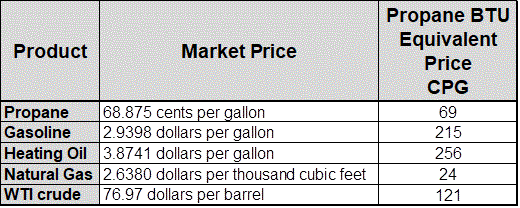
The second column of Table 1 is the price as normally reported for each product. Each product is in different units of measure and does not consider the Btu per unit of measure difference. It is very hard to compare the price or value of each of the products. But if each product is converted to its propane Btu equivalent and then into a common unit of measurement, like in the last column, the relative values are easy to compare.
Propane is higher than natural gas, but it is valued very favorably against crude, gasoline, and distillates. Again, that has been constant throughout all the volatility in the market. Propane is oversupplied in the US and has been for a while. It is priced to export.
While the supplies of crude and refined fuels are tight in the United States, propane is not.
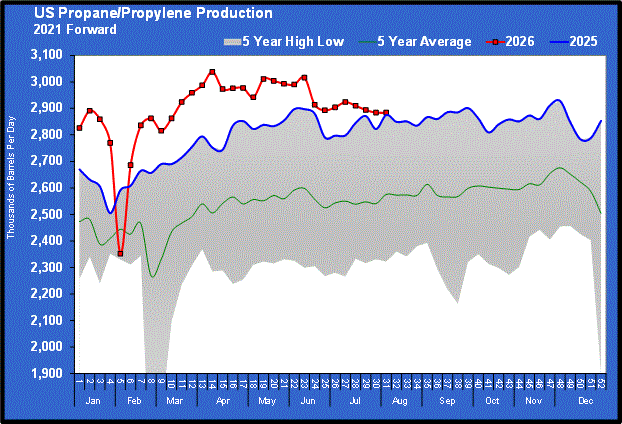
Chart 1 shows U.S. domestic propane production. It is high and has been growing at a rapid rate for years. The supply of propane is dictated by how much domestic crude and natural gas is produced. Those have been growing, so propane’s supply is also growing. Meanwhile, U.S. domestic demand has not been growing. In fact, it has been declining.
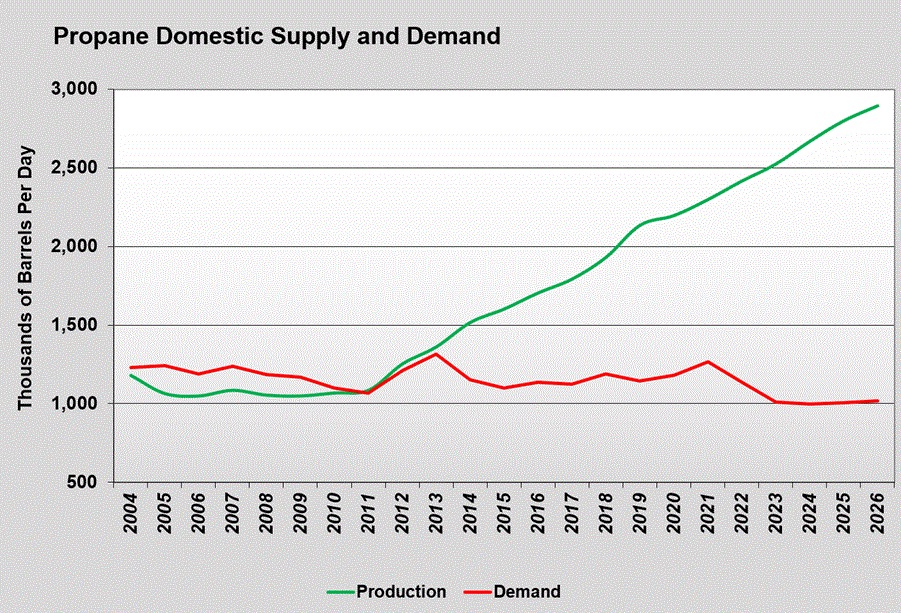
Chart 2 shows that until the shale gas revolution, the United States was net short on propane. From 2011, U.S. production started climbing. Propane demand increased alongside production for a few years, but since 2013, propane supply has continued its upward trajectory while demand fell. Unfortunately, in recent years, domestic propane demand has taken another leg lower.
Recently, U.S. petrochemicals have been favoring cheap ethane over propane. Retailers have been dealing with winters that have had fewer heating degree days than the previous year for several years in a row. Dryer and milder conditions during agricultural harvest time have taken the pressure off crop drying demand, too.
In our daily report, we provide a five-year look at propane’s value to crude as a barometer of how the value of propane compares to crude.
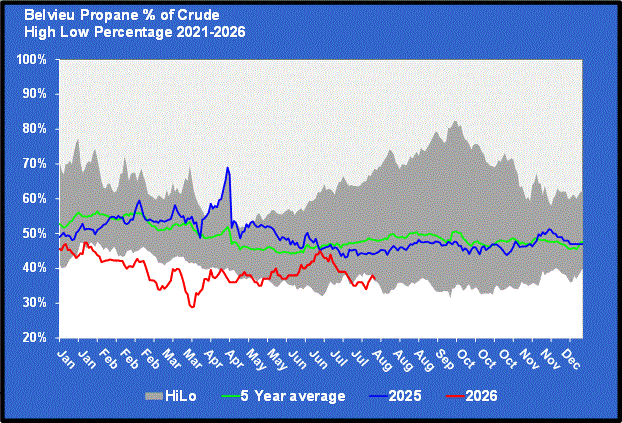
Chart 3 shows that propane has hit new five-year lows for much of 2026. There was a brief surge when foreign buyers showed up a month or so after the Strait of Hormuz closed. But more weeks than not, the chart shows that propane was a relatively cheap Btu.
This is part of a longer-term trend.
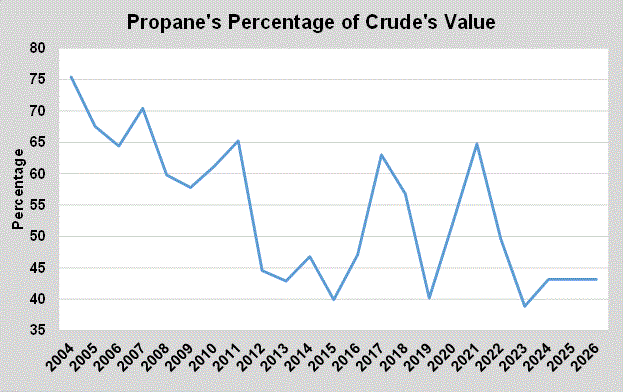
Propane has had a couple of periods when its value relative to crude jumped, usually related to increased export capacity. But the overall trend is that the relative value of propane to crude is falling. It reflects propane’s oversupply situation.
What is very unfortunate is that propane, even though relatively cheap, has not been able to expand its market against other forms of Btus. High natural gas production volume and its relatively low value to propane is a constant pushback against propane demand.
COVID-19 changed the pattern of the population consolidating in cities to some degree, but it has not shown up in energy demand beyond the natural gas distribution systems. We are hopeful that the current administration’s emphasis on bringing industry back to the United States will eventually result in an upturn in more rural energy demand. Industrial facilities are more likely to be located away from city centers, and workers will locate around them. That could cause an increase in energy demand beyond what natural gas distribution systems can currently reach. There is also the possibility of more forklift fuel demand associated with U.S. industries.
There is also the unknown of what data center energy consumption is going to do to energy prices overall. As more stress occurs on the electrical grid and more natural gas is used to generate electricity, is it possible that industry will once again be interested in propane systems for peak shaving? For years, U.S. industries have been dismantling their propane systems. Many propane retailers may have bought their tanks or are using them in some way.
We want to be clear that it is not possible for propane to be priced cheaper than natural gas, as natural gas processing plants will stop separating the propane if natural gas prices and propane prices get close enough. They will leave more of the propane with the methane to go to the natural gas utility companies. The result will be less propane supply and higher propane prices.
However, the way propane peak shaving systems worked financially was that when natural gas demand got high, natural gas utility companies would pay industrial facilities that could switch to propane for brief periods a premium for the natural gas they were otherwise contractually obligated to provide. Obviously, they had to pay the industry more for their natural gas than the cost of the propane the industry would consume. So that situation did not require propane prices overall to be cheaper than natural gas.
When natural gas supplies got so abundant after the shale gas revolution, the peak shaving game was no longer a thing. But we do wonder if the expected high demand for electricity and natural gas that is occurring with data centers could make them viable again.
Perhaps the data centers themselves might install propane backup systems for not only the potential economic benefit but also supply security. Perhaps this is all wishful thinking, but it is a shame that relatively low-priced propane is unable to make some type of domestic energy market share inroads. Another consistency is that the downtrend in U.S. domestic propane demand needs to end.
Table and charts courtesy of Cost Management Solutions.
To subscribe to LP Gas’ weekly Trader’s Corner e-newsletter, click here.
You May Also Like
-
European natural gas inventories fall below normal
Sep 21, 2026 -
Strong run in propane prices
Sep 14, 2026





Subscribe to LP Gas
If you enjoyed this article, subscribe to LP Gas to receive more articles just like it.