


LPG Spotlight: Heart of Texas Propane

Mark Riley arrived in Kerrville, Texas, on July 6, two days after devastating floodwaters from the Guadalupe River overwhelmed the town.
The CEO of Heart of Texas Propane, a retailer with 10 locations in central Texas, was there to check on his customers and operations. Riley and his team wanted to make sure that propane systems were safe and that tanks weren’t leaking. Spilled propane reaching an ignition source would worsen a disaster in which up to 15 in. of rainwater fell July 4 and early July 5.
The rain and subsequent flooding swept away homes and summer camps for children along the Guadalupe. At Camp Mystic, a Heart of Propane customer, 27 girls and counselors died.
Riley soon discovered that stormwater had ripped propane tanks from some of his customers’ properties and that the crisis was more than his company could handle. He contacted Jackie Mason, deputy executive director of the Texas Propane Gas Association, and the Texas Railroad Commission, asking what the protocol was for disasters involving propane tanks.
“We found out there wasn’t one,” Riley says. “The railroad commission representative told us to keep doing what we were doing – mitigate the risk, remove tanks from the debris, deactivate the tanks and not let heavy machine operators touch them.”
Thanks to the efforts of industry leaders and Texas retailers, including Riley, the TPGA is now working with the National Propane Gas Association on a disaster protocol.
Meanwhile, Heart of Texas Propane, Kerrville and other parts of central Texas are still recovering from the floods, in which two of Riley’s customers lost their lives. The company’s 10 offices, for the most part, were undamaged, and no trucks or equipment were lost. But the Kerrville operation is down customers and has been making 30 percent fewer deliveries as their customers recover.
The disaster deeply affected Riley. He observed that although people were initially in shock after the floods, they quickly realized what they had to do to recover, tapping into their faith. It was a lesson in resilience.
“There’s a lot of love going on down there,” Riley says. “People are leaning on people and helping out. It’s sad that a disaster had to bring that out, but it was good to see. It made us feel good that we could be part of that.”
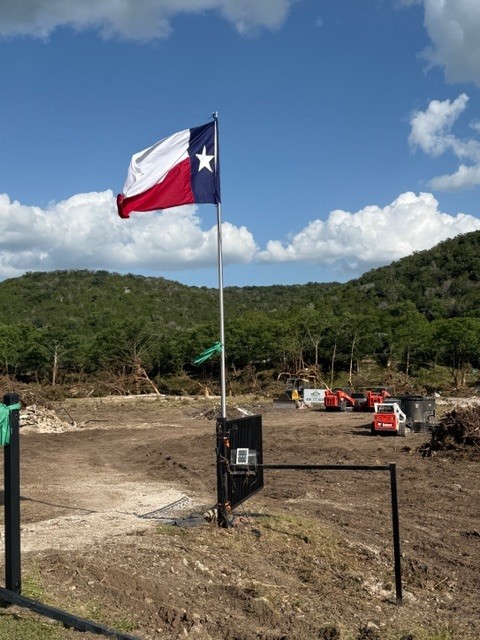
An unprecedented rainfall
The Guadalupe at Kerrville is shallow and narrow in some places, so when an outrageous amount of rain began falling July 4, the river rapidly overflowed, surging more than 22 ft. in just a few hours, CNN reported.
“The water was moving extremely fast to do the damage it did,” Riley says. “There were large cypress trees that are no longer there. Homes were left only with their foundations. Cars were unrecognizable.”
Although Riley arrived in Kerrville on July 6, he wasn’t able to connect with customers in the river basin until the next day because first responders were rescuing people and removing debris. Once he and his team reached the river basin, their mission changed: Help everyone, providing food, water and comfort, regardless of whether they were customers or even had propane systems.
“Some people were still in shock,” Riley says. “There was some survivor’s guilt. We gave a lot of hugs and prayers and spent a lot of time with people.”
For those with propane systems, Riley and his team ensured they were safe and shut them off. Some tanks were still there but had been moved by floodwaters.
Meanwhile, thousands of volunteers, some with heavy equipment like excavators, trickled in to clear debris. Riley noticed that some were trying to lift propane tanks. That could be a problem if the tanks had been punctured.
On July 10, Riley met a supervisor of heavy equipment at Camp La Junta, another children’s camp and a Heart of Texas customer, in Hunt, Texas, about 12.5 miles west of Kerrville. The supervisor was a friend of U.S. Rep. Chip Roy, and Riley sent a message to the congressman, telling him that heavy equipment operators should not touch propane tanks.
Then, on July 11, Mason called and told Riley that several propane retailers wanted to help the recovery effort. Pico Propane and Fuels in San Antonio and AmeriGas in Houston, among other companies, gave money and resources.
Two days later, representatives from Pico Propane and Fuels, AmeriGas, Chaparral Propane in Ingram, Texas, Heart of Texas, the TPGA and other retailers formed the Hill Country Propane Emergency Response Team. Led by Mark Holloway of AmeriGas, they hit the ground running on July 14, gathering orphaned tanks from the river basin and storing them outside the Heart of Texas Ingram office.
The railroad commission helped to inventory all the tanks, which were inspected, catalogued and tagged. Tank descriptions were posted on the railroad commission website so that the owners could claim them.
“Those tanks are mostly still in our yard,” Riley says. “Only one or two were claimed. We will repair the tanks still useable and donate them to those who need them. We’ll scrap the damaged ones and donate the proceeds to flood relief.”
Riley and his crew are still hurting for the families who lost loved ones.
“One little girl is still missing,” Riley says. “Another gentleman hasn’t been recovered. The river may never give them up. Our prayers are still with their families, that they can have some sort of closure and strength to get through this, and get to a place of peace.”
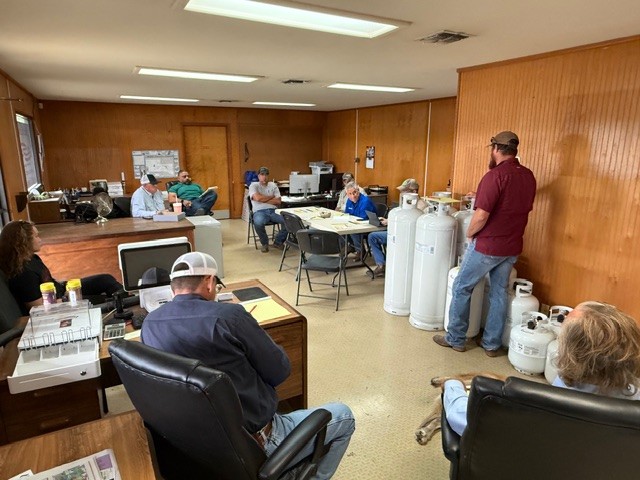
Company Profile: Heart of Texas Propane
Year founded: 2017
Headquarters: Brady, Texas
Founders: J. Bryan King, managing partner of LKCM Headwater Investments, and the King family
Owner: LKCM Headwater Investments, a private investment firm in Fort Worth, Texas
Annual propane gallon sales: About 4 million gallons
Number of bobtails: 22
Number of employees: About 50
Online: hotpropane.com
Featured homepage image: DarcyMaulsby/iStock/Getty Images Plus
Related Article
Propane retailers provide relief after major Texas floods
Other LPG Spotlights
You May Also Like
-

LP Gas Hall of Fame profile: Brian Sheehan
Mar 30, 2026 -

Propane Personality: David W. Lowe
Mar 29, 2026 -

LP Gas Hall of Fame profile: Denis Gagne
Mar 27, 2026




Subscribe to LP Gas
If you enjoyed this article, subscribe to LP Gas to receive more articles just like it.