

Fuel-price spread sharpens business case for propane autogas
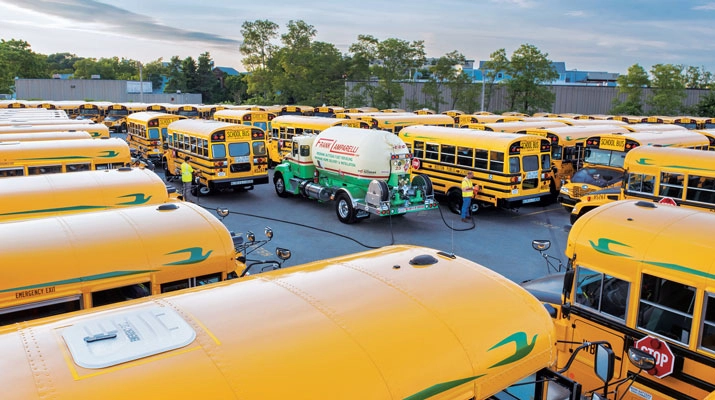
Every gasoline- or diesel-powered vehicle in a propane retailer’s yard represents both an operating expense and a credibility test. A fleet prospect hearing that autogas lowers costs may reasonably ask why the propane company is not using its own fuel.
That question carries more weight as conventional fuel prices strain operating budgets. On Sept. 11, AAA reported national averages of about $4.30 per gallon for regular gasoline and $6.06 for diesel, compared with $3.19 and $3.71, respectively, one year earlier.
Those pump averages are not a perfect fleet comparison. Autogas prices vary by region, volume and contract, and propane’s lower energy content generally raises gallon consumption versus gasoline. Still, the current spread produces substantial savings.
“Most fleets look at it from a cost-per-mile perspective, and at today’s prices we are seeing fleets save in excess of 40 cents per mile on fuel costs alone, not including maintenance,” says Todd Mouw, executive vice president of Roush CleanTech. “There is no other proven solution like propane autogas that can deliver the positive financial impact without sacrificing key attributes such as range, performance or payload.”
Joel Stutheit, senior manager of autogas business development for the Propane Education & Research Council (PERC), estimates fuel savings of 40 percent to 50 percent. He attributes propane’s pricing stability to abundant U.S. production.
“Propane autogas has the most stable pricing compared with gasoline and diesel,” Stutheit says. “It has been a very stable fuel that fleets can count on with their budgets.”
▶ Building the case

The price difference may attract attention, but a sale requires a calculation based on the operation.
Mark Denton, vice president of business development for Alliance AutoGas, starts with current fuel use, vehicle or conversion costs and the planned ownership period.
“If they’re a true fleet business, they pretty much know how many gallons of fuel they’re currently using on gasoline or diesel,” Denton says. “That’s a better calculation.”
Denton illustrates the approach with a gasoline vehicle consuming 4,000 gallons annually. He adds 15 percent to estimate propane use, producing a projected total of 4,600 gallons. In an example prepared earlier in September, with gasoline at $4.08 per gallon and tax-paid autogas at $2.08, annual spending falls from $16,320 to $9,568 – a savings of $6,752 for one vehicle.
Local prices, consumption, efficiency and equipment costs all affect the outcome, but the example shows why high-use vehicles generate the fastest returns. Alliance AutoGas models the cost of converting an existing vehicle or purchasing one already equipped for autogas, then calculates payback and lifecycle savings.
Mouw sees payback periods that are short relative to asset life in the markets Roush CleanTech serves.
“It depends on the application and miles driven annually, and whether we are competing against gasoline or diesel in the base application,” Mouw says. “In school bus, the payback is less than 18 months, and they keep the assets for 12-plus years. In public transit, it is less than 12 months based on the miles they run and fuel they consume.”
▶ Highest-use vehicles first
The strongest targets consume large quantities of fuel, return to a central location and remain in service long enough to capture the savings.
Roush CleanTech is concentrating on Class 4-7 applications, including student transportation, public transit and last- and mid-mile delivery. Airport shuttles and on-demand transit also combine high mileage with extensive idling.
“Those segments have key attributes in common,” Mouw says. “They run lots of miles annually, spend significant time idling and often can’t use electric vehicle technology because of cost, range or payload needs.”
PERC counts more than 60,000 propane autogas fleet vehicles on U.S. roads, according to Stutheit. School districts remain a leading adoption market, while paratransit is growing as operators seek predictable costs and a cleaner alternative to conventional fuels.
“The strongest case is with fleets that have high fuel consumption and high mileage,” Stutheit says. “They can see the benefit of the fuel savings and, compared with diesel, lower maintenance costs.”
The hub-and-spoke model improves the proposition because a fleet can refuel at its own base rather than depend on a public network. It also lets the propane marketer pair vehicle sales with a long-term fuel account.
You May Also Like
-

Hilco acquires J-M Transport from Crystal Flash
Sep 30, 2026 -

Denver Propane Exchange sells to undisclosed buyer
Sep 29, 2026 -

Propane market outlook
Sep 28, 2026



Subscribe to LP Gas
If you enjoyed this article, subscribe to LP Gas to receive more articles just like it.