


Propane prices remain stable, relatively cheap
Trader’s Corner, a weekly partnership with Cost Management Solutions (CMS), analyzes propane supply and pricing trends. This week, Mark Rachal, director of research and publications, parses through what is impacting propane prices and inventories.
Catch up on last week’s Trader’s Corner here: Reassessing after a surprising draw on propane inventories
In the previous Trader’s Corner, we looked at propane imports, exports, production and domestic demand in response to a draw on propane inventory for the week ending April 24. Our purpose was to show what might be expected relative to propane inventories should the war between the United States and Iran continue. Our conclusion was that, despite the drop in inventories, they were likely to resume building but would peak at around 92 million barrels by Sept. 30 and not reach the record 106 million barrels set before this past winter.
The Energy Information Administration (EIA) reported an even larger draw on inventory of 1.290 million barrels for the week ending May 1. That news made us squirm in our seats a bit. But we remain confident that propane inventories are not destined to continue to draw. Propane exports dropped 232,000 barrels for the week. That put them at 2.028 million barrels per day (bpd), just above the 2 million bpd we assumed in our estimate. Imports and production didn’t cooperate, with declines in both, but we are confident they will bounce back. The big departure from our estimates came from domestic demand. It increased by 182,000 bpd to 1.170 million bpd. We remain confident that domestic demand will not be anywhere near that high in the coming weeks. We still like our 800,000-bpd average for the next five months to be correct.
So, despite 2.5 million barrels in inventory draw over the last two weeks during a period we would normally expect a build of about that much, we are not panicking. Squirming? Yes. Panicking? No. It seems propane markets are in the same mindset. There was a muted response when the EIA reported the second inventory draw on May 6. Propane was down with falling crude that day, and it stayed there. The possibility of peace between the United States and Iran dominated the market, leaving little room for information on energy fundamentals to have much impact. For the most part, it is a headline-driven market. However, on May 8, propane separated from crude, with propane prices outpacing crude prices.
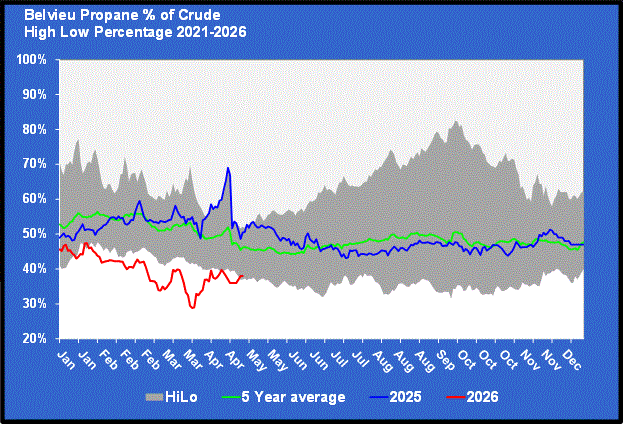
Chart 1 plots MB-ETR propane’s value relative to WTI crude’s value. The red line is this year, the blue line is last year and the green line is the five-year average. The gray area plots the five-year high/low range. As the chart shows, propane is still near a five-year low in value relative to WTI crude. It is not surprising that the recent developments with propane inventories would cause traders to think propane shouldn’t have such a relatively low value.
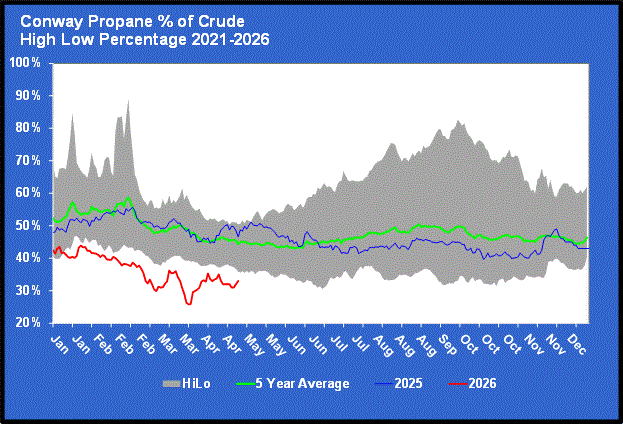
The relative value at Conway is even lower than at Mont Belvieu.
The reality is that propane has been going up recently, but it remains a relatively cheap Btu. There is no doubt that the war between the United States and Iran has had a negative impact on propane consumers. But compared to other energy sources, propane has fared well. Table 1 compares the change in the price of propane to crude and refined fuels over the past year.

MB ETR propane is up 16.4 percent and Conway is up 7.02 percent over their May 8, 2025, prices. WTI crude is up 36.48 percent, heating oil 46.55 percent and gasoline 39.30 percent. Heating oil is valued at the equivalent of $2.55 per gallon of propane. Gasoline is valued at the equivalent of $2.51 per gallon of propane.
The U.S. propane market was oversupplied before the war between the United States and Iran. With exports running two times domestic demand, propane is still oversupplied in the United States.
With propane, the supply side is relatively inelastic. Supply is based on crude and natural gas production. Propane supply, therefore, does not respond much to changes in pure propane demand. When the war is over, propane demand should fall, while supply will remain high, causing the oversupply situation to result in builds on inventories once again.
We all know and have known that propane has been in a perpetual state of oversupply for the last few years, reducing the need to hedge against higher prices. When propane is oversupplied, it is correct to reduce the amount of hedging or price protection. But recent events show that some level of price protection is always prudent. The energy market overall is global and is highly influenced by economics and geopolitical events. Though U.S. propane is in a strongly oversupply situation, allowing it to resist the rise in the energy markets overall, it is still influenced by the bigger picture.
Even though propane is oversupplied and the odds of needing price protection are reduced, it remains prudent to place hedges or price protection when market conditions give the buyer a low-risk entry point. In an oversupplied market, the odds are increased that the spot market at the time of delivery will be at or below the hedge price. If it is, the buyer might lament the hedge position.
Hedging is about managing risk. As the current situation shows, there are risks to higher prices even in an oversupplied market. Managing the “event” risk in this situation means taking less of a hedge position and making sure the entry point is good, for example, below the 10-year winter price average.
If propane exports remain elevated, the risk profile will see an increased risk of higher prices. In that case, managing the risk appropriately likely means a larger hedge position and a willingness to enter the hedge at a higher price.
Charts and table courtesy of Cost Management Solutions.
To subscribe to LP Gas’ weekly Trader’s Corner e-newsletter, click here.
You May Also Like
-

Propane market outlook
Sep 28, 2026 -
European natural gas inventories fall below normal
Sep 21, 2026 -
Strong run in propane prices
Sep 14, 2026



Subscribe to LP Gas
If you enjoyed this article, subscribe to LP Gas to receive more articles just like it.