


State of the Industry: Preserving energy choice
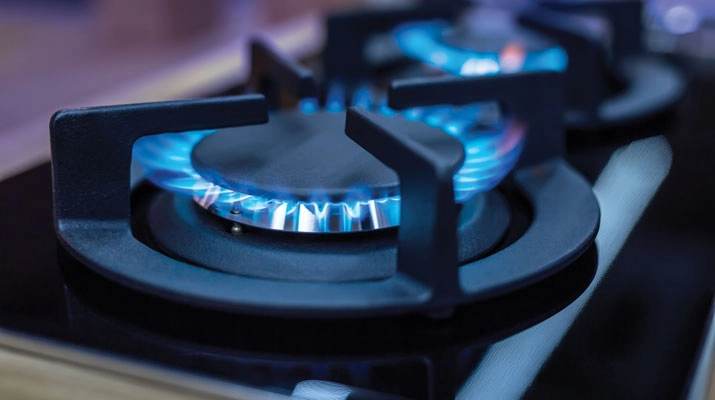
The fight to protect energy choice in New York took a positive turn for the industry late this year when the state agreed to pause a gas ban set to take effect Jan. 1, 2026.
Propane industry stakeholders at the local, state and national levels have led a coalition against the All-Electric Buildings Act and climate framework that they call one of the most aggressive in the country.
Their efforts to challenge the law in federal court led New York to formally stipulate to suspend its enactment during the appeals process. This outcome is viewed not only as a short-term win but a moment of opportunity to strengthen consumer protection and help the state recognize the essential role of propane.
“The pause on the gas ban isn’t about stopping climate progress. It’s about making climate policy work in the real world,” says Christina Armentano, executive vice president and COO of Paraco Gas, who also serves as president of the New York Propane Gas Association (NYPGA).

No one knows what the future holds for New York, which consumed 430 million gallons of propane in 2024, according to the latest sales report completed by Frost & Sullivan on behalf of the Propane Education & Research Council. Its gallon sales rank third highest in the United States, revealing just how impactful a gas ban would be for the Empire State and the entire propane industry.
“Right now, as of Jan. 1, it is business as usual, so that is the good news,” Armentano says. “The fight is not over, though. So even though this is a win, it is a short-term win. We really need to, as an industry, double down on our advocacy efforts.”
What’s unfolded in New York coincides with other actions and discussions taking place at statehouses and in government offices across the United States. In a political and regulatory environment ripe with division, views on consumer energy choice have pitted the states in varying camps. It’s also influencing decisions within the propane industry to ensure that retailers and their customers aren’t handcuffed by regulations.
“In some respects, the states are taking sides,” says Stephen Kaminski, president and CEO of the National Propane Gas Association (NPGA), which is leading the charge in New York alongside the NYPGA and Mulhern Gas of Hudson, New York.

“We have a federal government now that is more amenable to an all-of-the-above energy approach, which for propane is excellent. So, you see a lot of states supporting that,” he adds. “But you also see certain states doubling down on anti-gas policies because they know that the federal government is taking a more all-of-the-above energy approach. So, you do see some states being more aggressive in their pro-electric stances than previously.”
▶ Most states favor protections
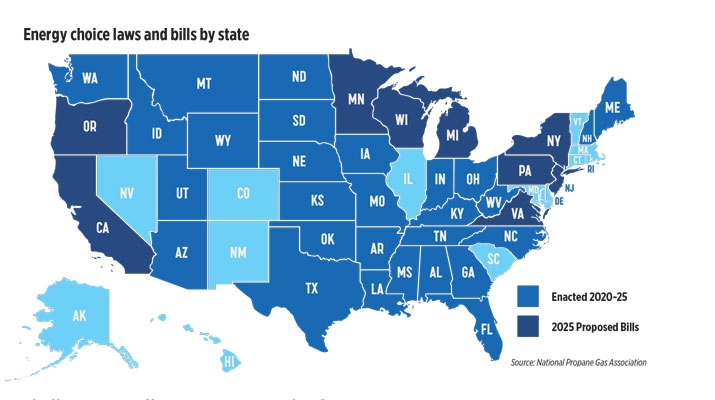
Industry efforts to protect the use of propane and other gas-burning appliances have spread across the United States. And fortunately for the propane industry, the U.S. map reveals that a majority of states have enacted energy choice laws.
Earlier this year, Maine became the 28th state to protect energy choice for consumers and businesses, with those states representing over 50 percent of all propane gallons sold in the United States.
Some states, however, pose more of a challenge. After Washington state voters approved a ballot initiative protecting consumer energy choice in November 2024, the initiative itself was challenged in court by groups who do not support energy choice. NPGA, the Pacific Propane Gas Association and others are pushing back to support the ballot initiative.
Oregon has introduced legislation that would give cities and counties the “constitutional authority to prohibit or limit use of fossil fuels in new buildings or installation of fossil fuel infrastructure.” Oregon also has an energy choice bill stuck in committee.
This follows the well-documented, first-of-its-kind gas appliance ban for new buildings in Berkeley, California, in 2019. The ruling was challenged in court and ultimately struck down by the U.S. Court of Appeals for the 9th Circuit in April 2024.
The battle to keep fuels like propane as a viable energy option for consumers and businesses is ongoing across the country, and it may be the new norm in today’s energy environment in which leaders hold varying opinions on climate-related solutions.
“We want to continue to push for protections in states that have not passed energy choice laws,” says Jacob Peterson, senior director of state advocacy and affairs at the NPGA. “We always want legal protections to set a tank, to run a supply line. We want legal protections for consumers and businesses to be able to buy the equipment and the products that burn our molecule. It is imperative for this industry.”

The battle has even become market specific. Over the past three or four years, states, counties and municipalities have pursued outright bans or phased out bans of internal combustion engines, Peterson says.
Some states are taking a proactive approach to make sure that doesn’t happen within their borders. Arkansas, Maine, Kansas, Iowa, Ohio, Oklahoma and Louisiana have enacted rules to prevent internal combustion engine bans, and NPGA says it will work with other states to champion similar efforts in 2026.
“We care about these protections because they protect end-use applications that are important to propane marketer members,” Peterson adds. “These are mobile engines. Think of forklifts, school buses, commercial lawn mowers, and there are also stationary engines. Think of an irrigation engine in Iowa or Nebraska.”
▶ The ‘grand slam swing’
While the NPGA continues to target the states where it can help move energy choice laws across the finish line, it’s also eyeing protections on a national level.
Protecting consumer access to propane became a key issue at Propane Days earlier this year. Hundreds of industry members attended the lobbying event in Washington, D.C., where they urged for the passage of the Energy Choice Act during more than 320 meetings with their elected officials on Capitol Hill.
“We’re working hard on a federal energy choice law right now,” Kaminski says. “We are continuing to be aggressive on energy choice.”
The Energy Choice Act (H.R. 3699 in the House and S. 1945 in the Senate) would protect consumer access to propane and other conventionally fueled appliances, including gas furnaces and water heaters nationwide. The legislation, introduced by Rep. Nick Langworthy, R-New York, and Sen. Jim Justice, R-West Virginia, has drawn widespread support from elected officials as well as state and federal organizations.
Co-sponsors of the legislation increased from 42 to 137 since the June event, says Kaminski, who has been “cautiously optimistic” about the NPGA-led bill passing the House. The House Energy and Commerce Subcommittee on Energy and its full committee passed the legislation, sending the Energy Choice Act to the House floor for a vote. If it passes House vote, it will proceed to the Senate where 60 votes are needed for passage because of filibuster rules.
“It’s not only a home run swing. It’s the grand slam swing,” Kaminski says of the Energy Choice Act, which would make consumer energy choice protections the law of the land in the United States.
Also on a national level, certain members of Congress are considering another reform of the Energy Policy & Conservation Act (EPCA), Kaminski has shared at industry meetings. It was passed initially in 1975 and last reformed in 2007. It establishes a national, comprehensive energy policy and ensures uniformity, preventing patchwork local restrictions, according to the NPGA. In fact, the U.S. Court of Appeals for the 9th Circuit cited EPCA as the basis for overturning the Berkeley gas ban in 2024 because it preempts state and local regulations.
NPGA has outlined four major positions on EPCA reform and has begun meeting with key committee members in the House and Senate.
“If EPCA gets reformed, every segment of the energy sector is going to have their wish list, their suggestions,” Kaminski says. “We are definitely part of that mix.”
▶ Down to the wire
Back in New York, Armentano admitted to losing sleep in the days before the NPGA- and NYPGA-led coalition negotiated a stipulation with the state to pause the gas ban.
“This is one of the most important issues out there,” she says. “If we get banned as an industry in the state of New York, we do not have a future.”
Similarly, Kaminski has called New York’s gas ban attempt an existential threat to the industry.
The All-Electric Buildings Act aims to prohibit the installation of propane, natural gas and oil appliances in most new buildings under seven stories, including residences, starting in 2026 and expanding to larger buildings in 2029. The gas ban is part of the larger Climate Leadership and Community Protection Act, the state’s big-ticket climate law from 2019 that puts numerous initiatives in motion.
“We all want to move toward a greener future as a nation and as a state. There’s no question that reducing our carbon footprint is the right direction,” Armentano explains. “But getting there requires an approach that is both economically sound and rooted in common sense. The path forward must be multi-pronged. It cannot be a one-size-fits-all solution, and that’s why energy choice is so important.
“I truly believe over the last 60 days, people are starting to wake up because they understood what was really at stake come Jan. 1.”
As the calendar turns to 2026, the NPGA, state and regional propane associations and their member companies – like in New York – will continue their work to defend industry interests. There is no other choice to keep propane relevant into the future.
“Anything that distorts the market to our disadvantage is something we’re always going to focus on,” Peterson says. “We want a level playing field because if we have one, we feel like, more often than not, consumers will choose our product.”
You May Also Like
-

Cetane celebrates 20 years in business
Mar 25, 2026 -

LP Gas Hall of Fame profile: Bob Barry
Mar 25, 2026



About the Author: Brian Richesson
Brian Richesson is the editor in chief of LP Gas Magazine. Contact him at brichesson@northcoastmedia.net or 216-706-3748.


Subscribe to LP Gas
If you enjoyed this article, subscribe to LP Gas to receive more articles just like it.